Author: Tux | Brooklyn Homemaker

A food and lifestyle blog focused on gussied up american classics, baked goods with a history, and schnauzer babies.

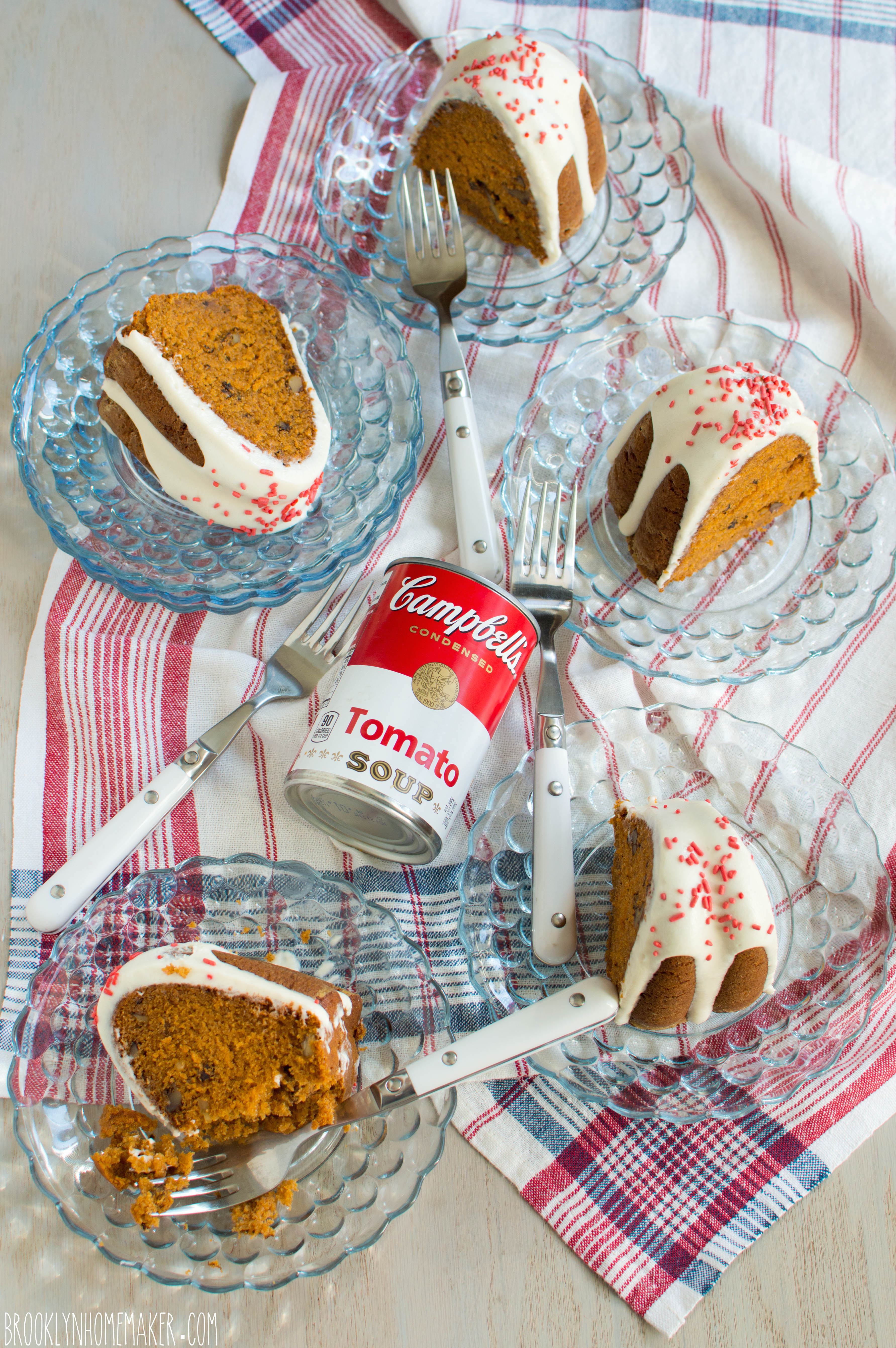
tomato soup bundt cake #bundtbakers

When I first started Brooklyn Homemaker, I hoped it would be an outlet for not only my love of food, but also for my love of food history and my off-the-charts food nerdiness.
tomato soup bundt cake | Brooklyn Homemaker

I used to post lots of recipes (especially cake recipes) with fun details and anecdotes about their histories, how they came to be, and why we were still making and eating them today. As much as I still love writing these kinds of posts, life gets in the way and the fact of the matter is that researching the history of a recipe is a lot more involved and a lot more time consuming than just whipping something up on a whim. I also thought that I’d sort of exhausted my supply of cool, iconic desserts with histories that I’d find interesting enough to write about. That is, I thought I had until this month’s bundt bakers.
tomato soup bundt cake | Brooklyn Homemaker

Felice of All That’s Left are the Crumbs chose Retro Desserts as our theme this month, and I was all over it! You know how much I love an old cookbook, and I kind of feel like this theme was hand selected to appeal to me! Thanks Felice!

To me the word “retro” always inspires images of the 50’s and 60’s, the atomic era, the age of ambrosia salads and jell-o molds. The days of gas guzzling pastel land yachts, wall to wall pink tile bathrooms, and single story cookie cutter ranch homes. I prefer my “old fashioned” dessert recipes from the 30’s and 40’s though, so I decided to go back a little further. People were doing all sorts of inventive things with food back then, either just to stretch their scarce resources, or maybe even to make their lives a little lighter and brighter.
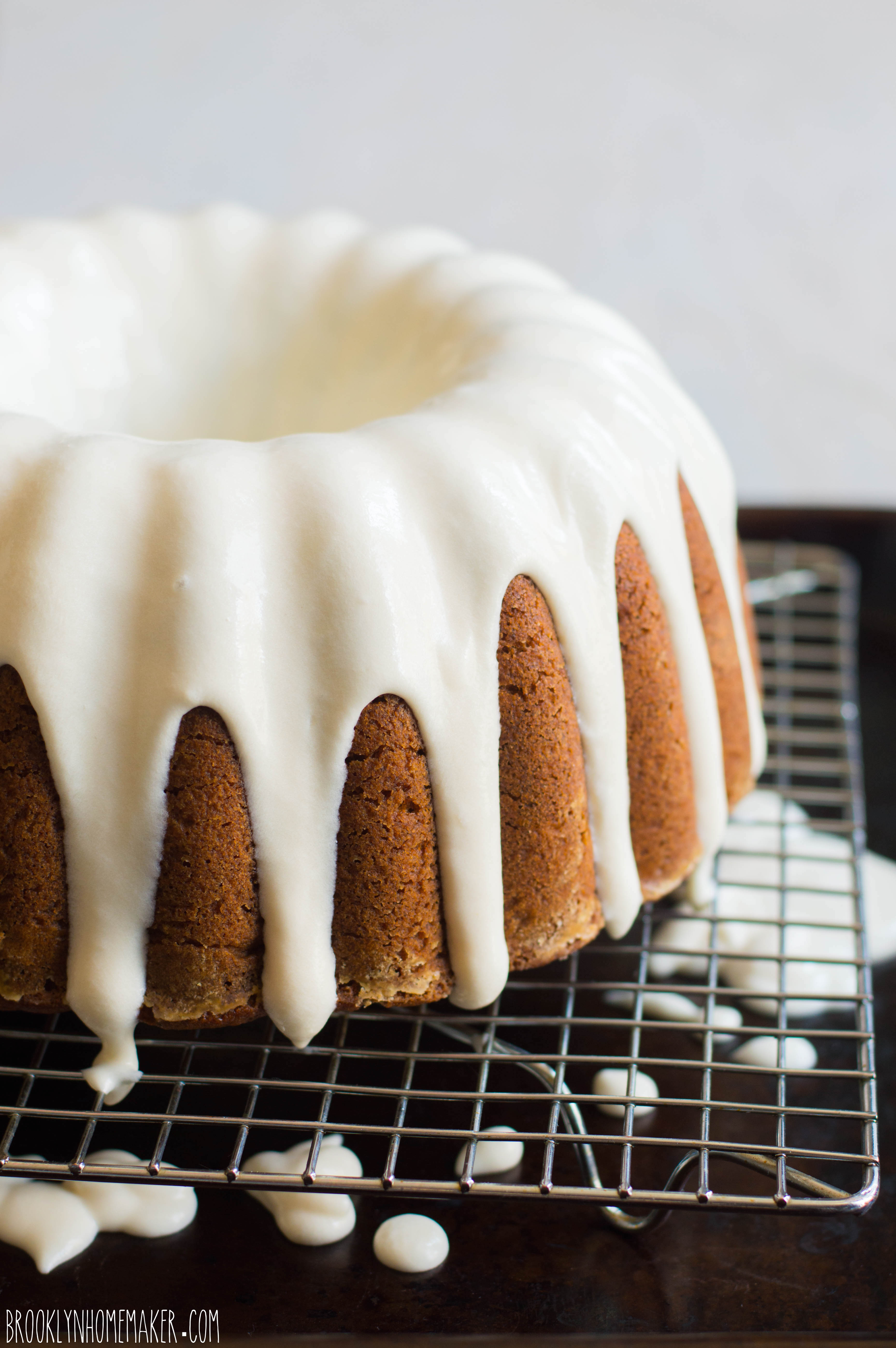
tomato soup bundt cake | Brooklyn Homemaker

My favorite (and most popular) dessert history post that I’ve written so far is Red Velvet Cake, which didn’t actually originate in the 30s, but did reach it’s wild popularity in that era. Long story short; a big food coloring and extract company started giving away a red velvet cake recipe, complete with color photos, to try to boost their struggling sales during the Depression. It worked like a charm and soon red velvet cake was on American tables, and in American hearts, where it’s managed to stay for almost a century.

Not surprisingly, the cake I’m posting today is another Depression era recipe, though not currently as well known and loved as Red Velvet. Originally called “Mystery Cake”, this spice cake contains a full can of condensed tomato soup. The “mystery” was that you’d never guess the “secret ingredient” if you didn’t already know.
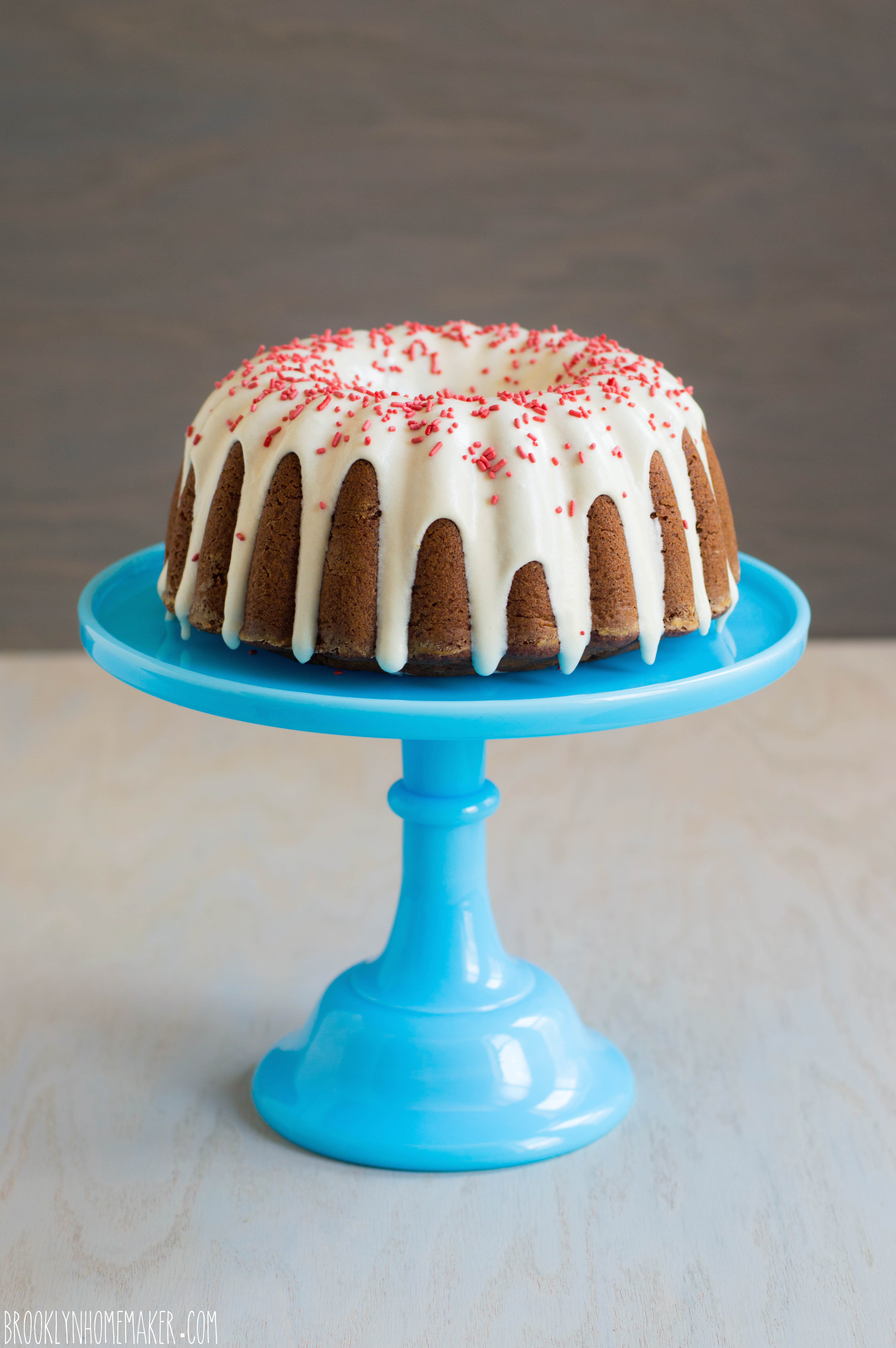
tomato soup bundt cake | Brooklyn Homemaker

This recipe most likely originated in the 20’s, as the first printed reference to it comes from a September 1928 notice about cooking classes in the Los Angeles Times. “The opening of the fall season is observed on the menu arranged by Mrs. Mabelle (Chef) Wyman for her demonstrating this afternoon… Under the dessert classification are velvet cake and mystery cake, a culinary idea of Mrs. Wyman’s skill.”

Mystery cake didn’t really become well known though until the Great Depression. The use of egg, dairy, and butter substitutes was very popular during this time because these grocery items were expensive and scarce. Grated or pureed vegetables like zucchini or carrots were popular substitutions for eggs and butter, as was applesauce, which remains a popular substitution for health conscious bakers to this day. Along with it’s moisture content, condensed tomato soup had the added benefit of an acidity that works as a flour conditioner. This meant that it could not only be used in place of butter, but could also replace the buttermilk usually used in baking to ensure a moist, tender, and delicate crumb.
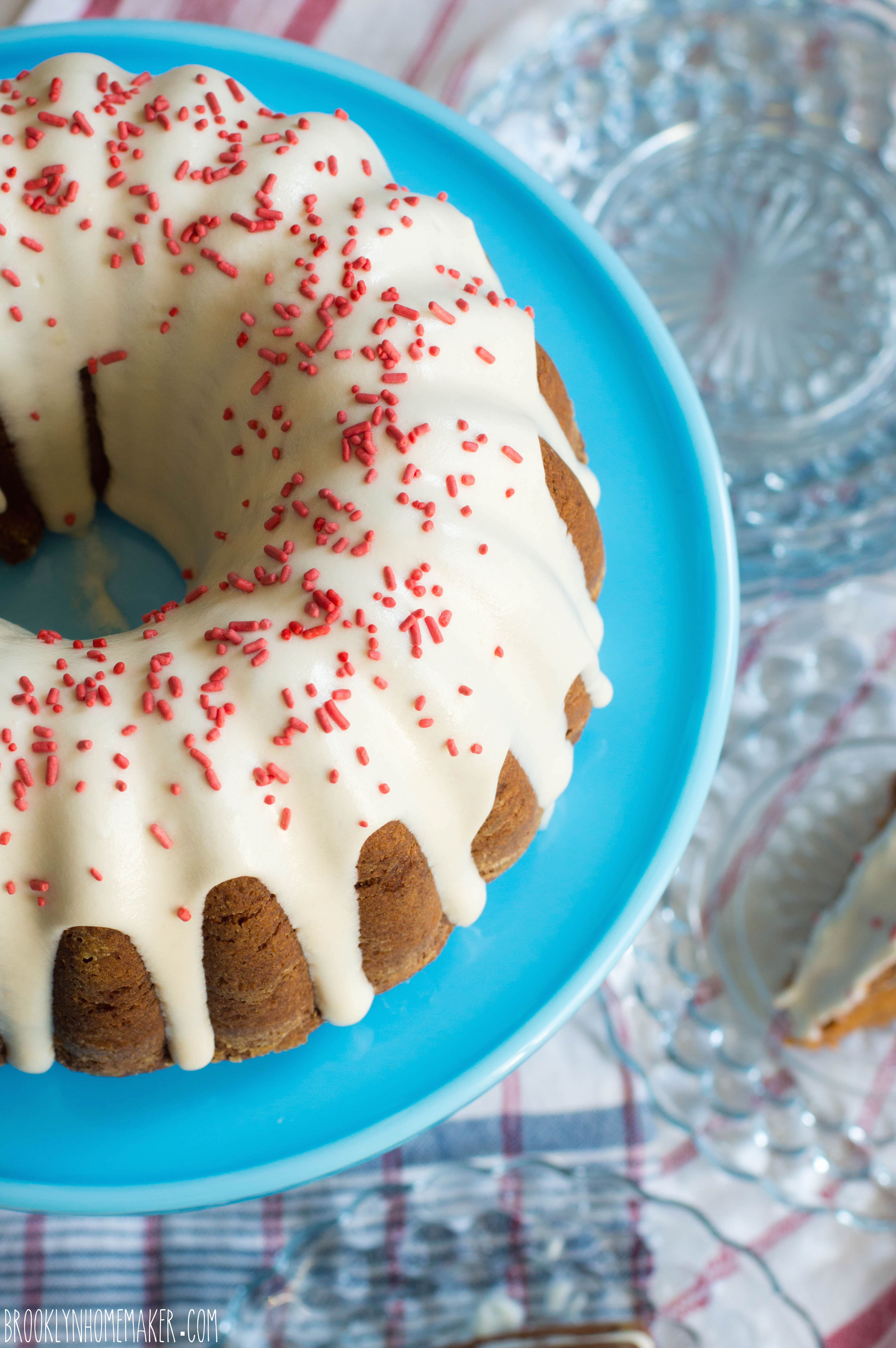
tomato soup bundt cake | Brooklyn Homemaker

Mystery Cake really took off in the early 1940’s when Campbell’s started promoting their own recipe during World War II. The same ingredients that were too expensive for home bakers in the 30’s were suddenly being rationed for the war effort in the 40’s and were even harder to come by. Canned food companies all over the country were using wartime rationing as a way to boost sales, and Campbell’s didn’t miss the opportunity. They quickly developed a recipe for Tomato Soup Cake that included only two tablespoons of butter and no eggs to appeal to homemakers with limited resources.
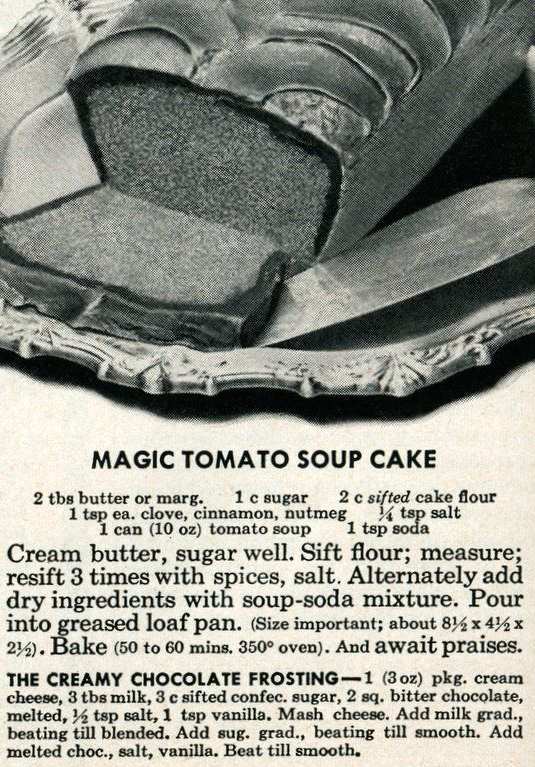
tomato soup bundt cake | Brooklyn Homemaker

The American food writer and cookbook author M.F.K. Fisher even included a recipe for Tomato Soup Cake in her 1942 book on wartime rationing and shortages, How to Cook a Wolf. Her recipe varied just slightly from Campbell’s but the idea was the same. “This is a pleasant cake, which keeps well and puzzles people while you are cooking other things, which is always sensible and makes you feel rather noble, in itself a small but valuable pleasure.”
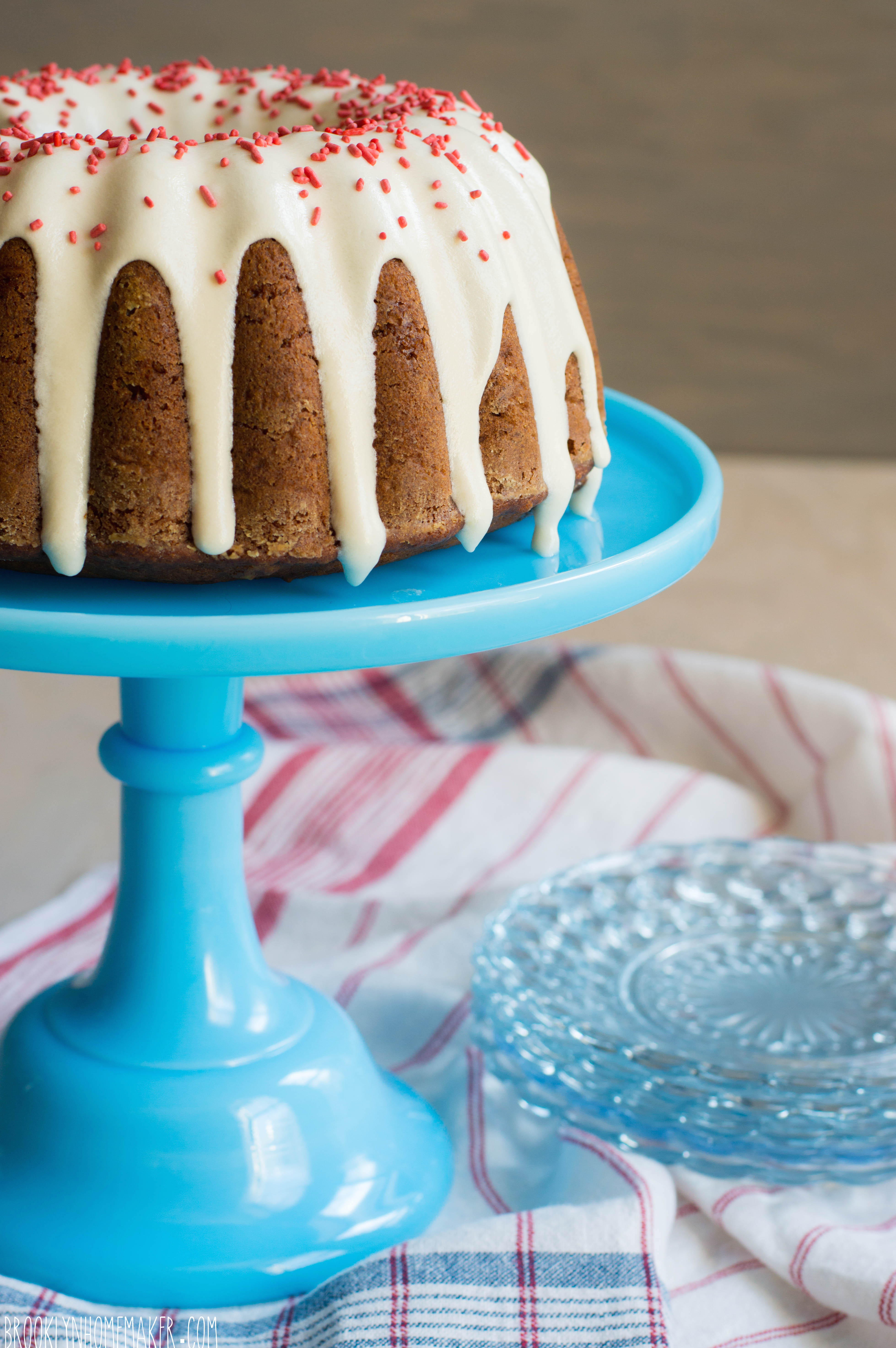
tomato soup bundt cake | Brooklyn Homemaker

Tomato Soup Cake remained popular even after the war, and another version of the recipe was included in the Joy of Cooking in 1964. Modern homemakers in the 1960’s and 70’s, fascinated with convenience foods and time saving tricks, loved to make their Tomato Soup Cake with boxed cake mixes.

Eventually the cake did wane in popularity though, and today many people have never even heard of it. I myself only discovered it a few years ago, and had a really difficult time wrapping my head around the idea when I first saw it. Eventually I warmed up to trying it, and by the time this month’s theme was chosen I was full well ready to give it a shot!
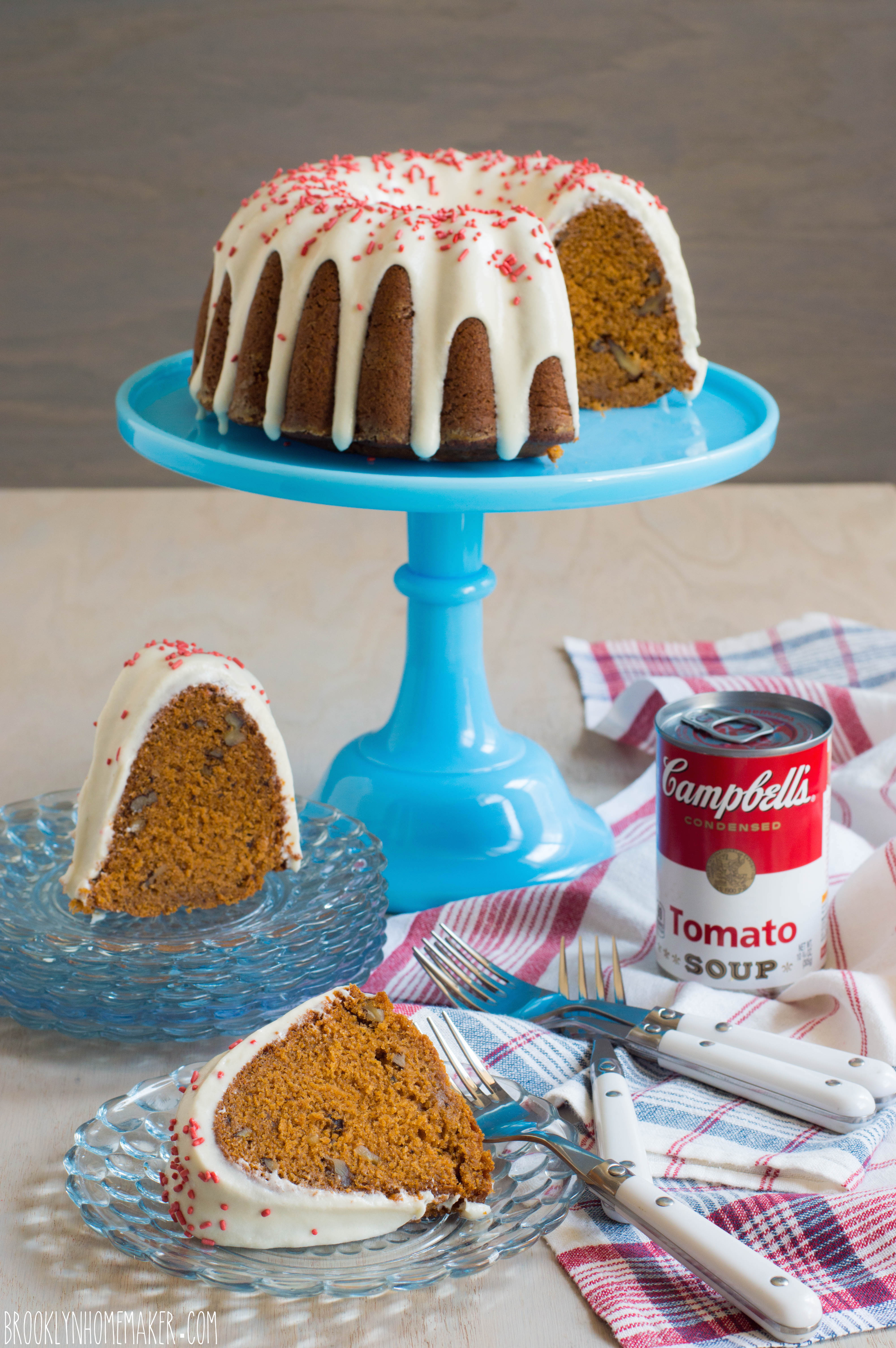
tomato soup bundt cake | Brooklyn Homemaker

Since the Great Depression and wartime rationing are now just distant memories, the butter and eggs have found their way back into most of the recipes you’ll find out there, including Campbell’s updated version. Of course, the tomato soup still remains as a way to add moisture, acidity, and interest to this simple spice cake.

Nuts and raisins have always been common additions to Tomato Soup Cake, and for my recipe I kept the nuts but skipped the raisins. Sorry raisin lovers. You can add them back in if you want.
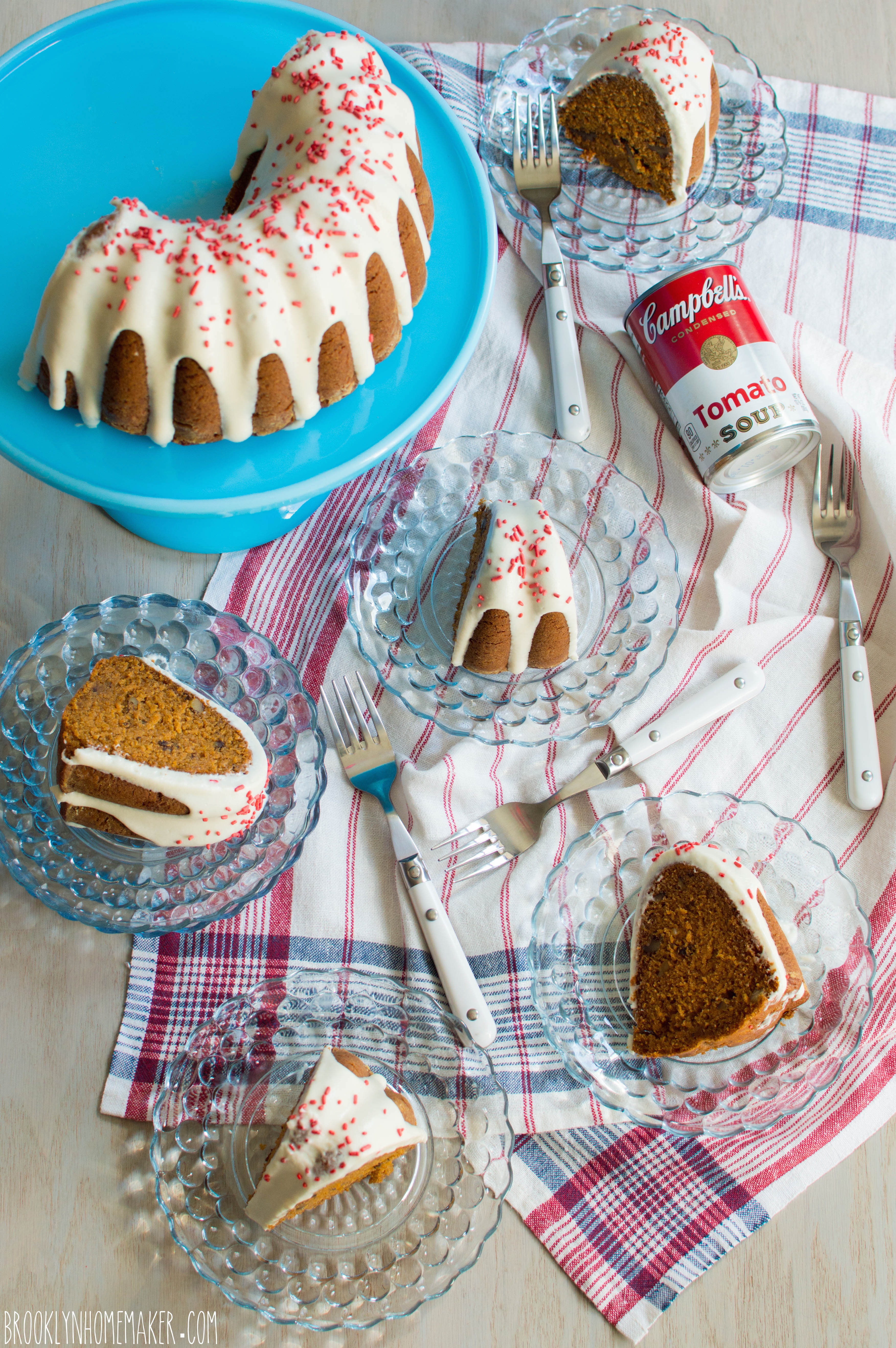
tomato soup bundt cake | Brooklyn Homemaker

Mystery Cake was definitely an appropriate name for this recipe. I was worried that the tomato soup would add a weird tinny chemical taste, but I really don’t think I could have figured out what was in it if I hadn’t baked it myself. The tomato soup concentrate adds a subtle sweetness and tang, and ensures that the cake is moist and keeps well for days. It has a perfect just-enough sweetness and a lovely touch of spice that doesn’t overpower the cake. The walnuts add a nice contrast in texture and a welcome touch of earthy bitterness.

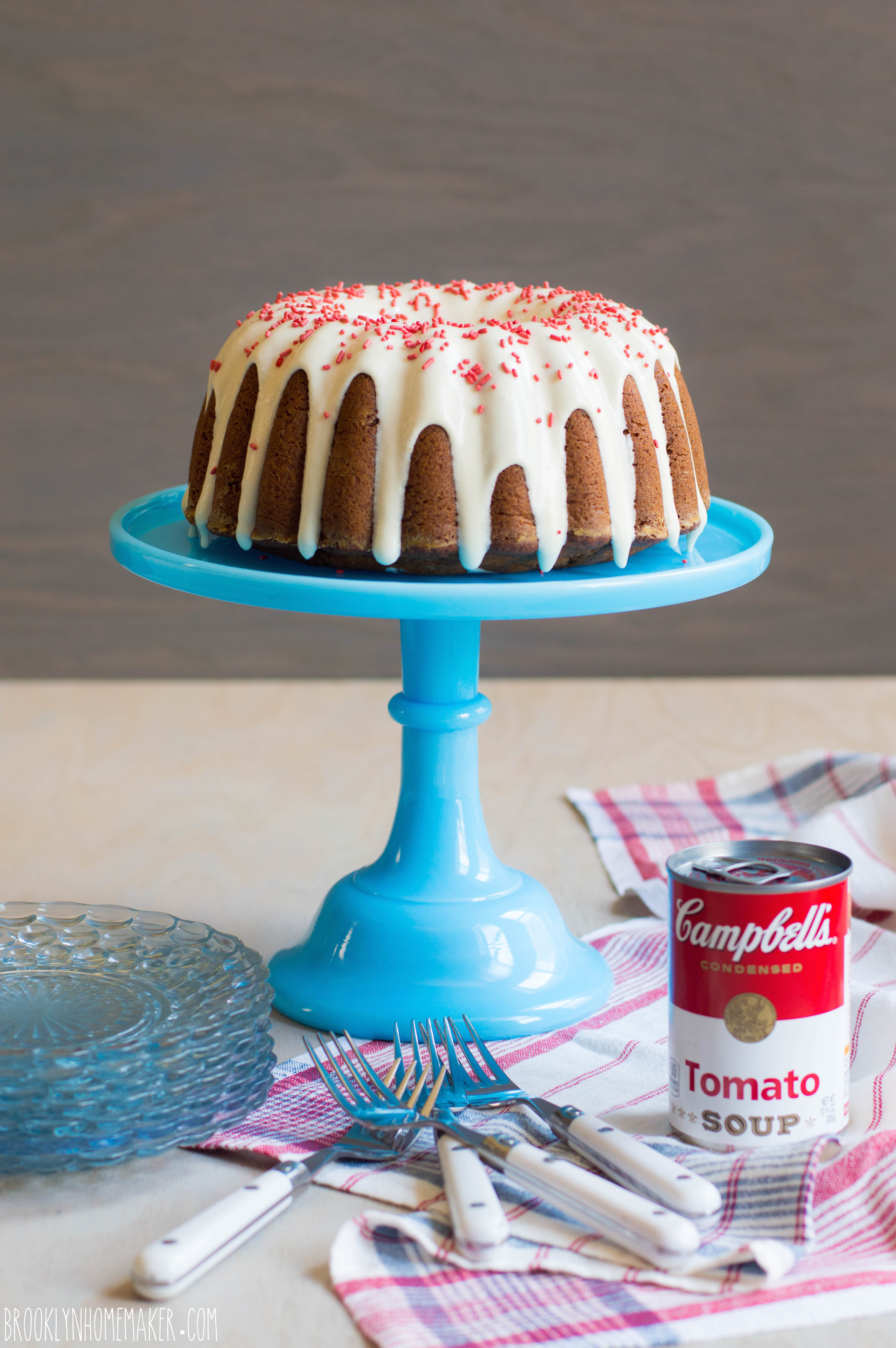
Many older recipes for Mystery Cake were topped with chocolate icing, but cream cheese icing has always been popular too. I decided to go for a drizzlable cream cheese glaze that adds sweetness and tang, and helps keep the cake from drying on the outer edges. I don’t usually go for sprinkles, but this fun retro theme got the best of me and I couldn’t help but add a handful of bright red jimmies as a play on the iconic tomato soup can!

Although this recipe has been around for almost a century, it definitely still feels relevant and delicious in these modern times. Why not step back in time and see what other retro bundts the talented team of bundt bakers came up with this month? Please scroll down past the recipe to find the links.
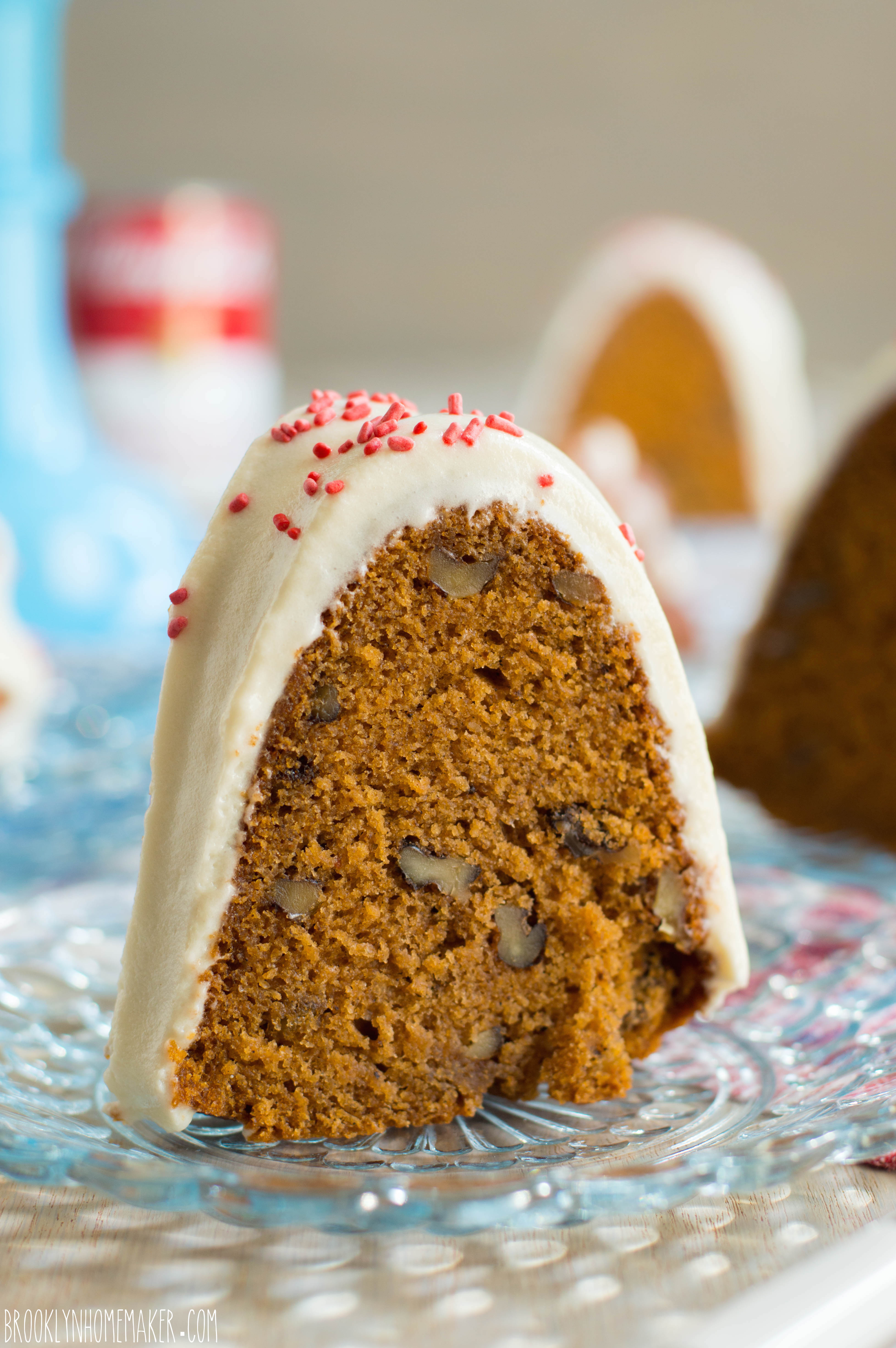
tomato soup bundt cake | Brooklyn Homemaker

Tomato Soup Bundt Cake

Adapted from several sources, mostly from Campbell’s

Cake:
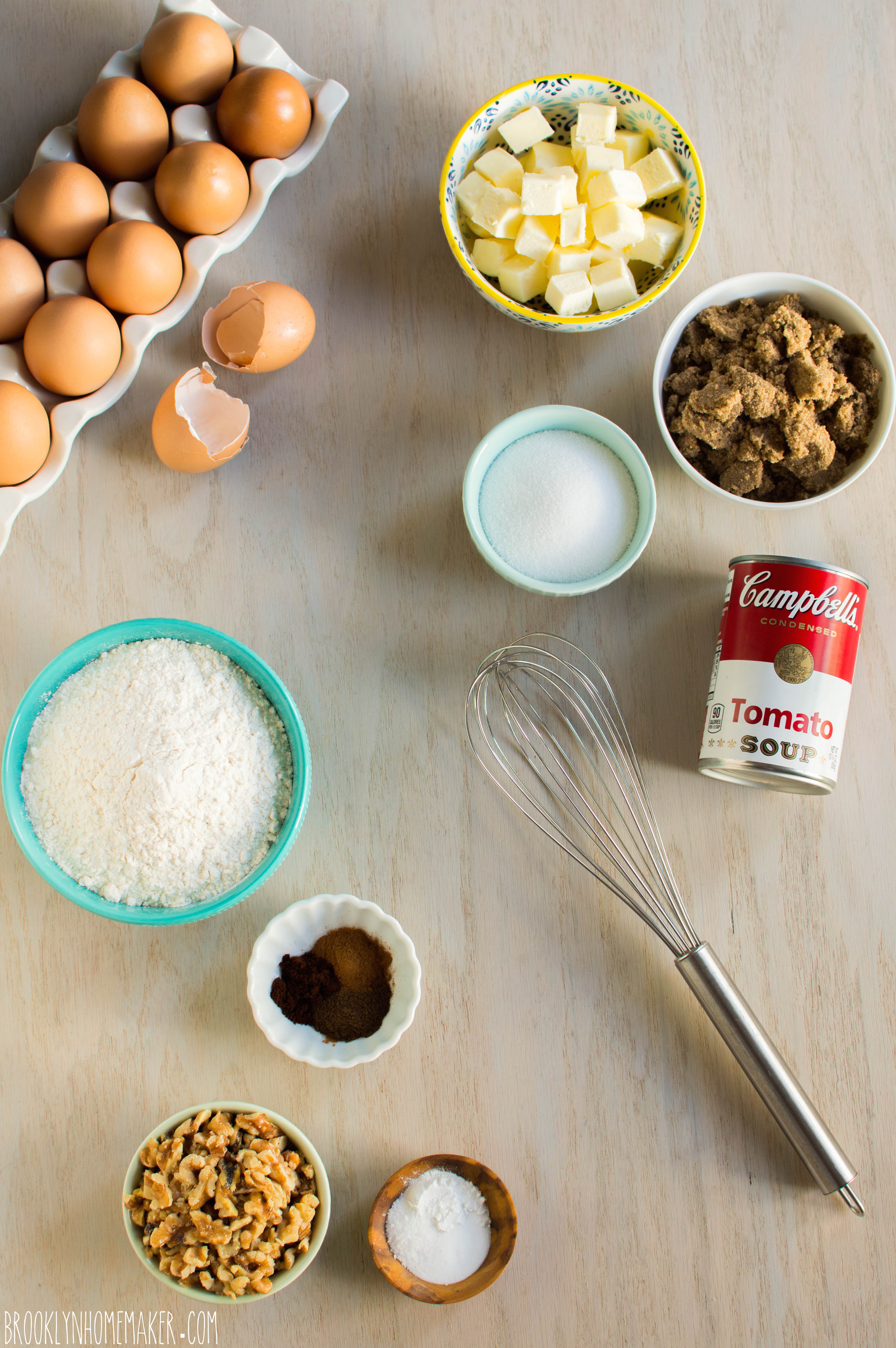
2 1/2 cups all-purpose flour
1 1/2 teaspoons baking powder
1 teaspoon baking soda
1/4 teaspoon salt
1 1/2 teaspoon ground cinnamon
1 teaspoons ground allspice
1/2 teaspoon ground cloves
1 can (10 3/4 ounces) Condensed Tomato Soup
1/3 cup water
3/4 cup (1 1/2 sticks) unsalted butter, softened
3/4 cup granulated sugar
3/4 cup packed brown sugar
3 large eggs
1 cup chopped walnuts (or pecans)

Cream Cheese Glaze:
4 ounces (1/2 package) cream cheese, softened
1 cup powdered sugar
1 teaspoon vanilla extract
4 to 8 tablespoons milk

Preheat oven to 350.
Butter and flour pan. Refrigerate.

Whisk flour, baking powder, baking soda, salt, cinnamon, allspice, & cloves together in a medium bowl. Set aside.
In a separate small bowl, whisk together condensed tomato soup and water until smooth.
Cream butter and sugars on high speed with an electric mixer until light and fluffy. Mix in eggs, one at a time, and scrape down the sides of the bowl. Alternate additions of the flour mixture and the tomato soup mixture, beginning and ending with flour. Mix each addition just to combine. Do not over-mix.
Stir in walnuts just until evenly distributed.

Pour into prepared bundt pan and bake for 45 to 55 minutes. Cool on a wire rack for 15 to 20 minutes. Invert the pan and turn the cake out onto the rack to cool completely before glazing.

While the cake cools, make the glaze.
In the bowl of a stand mixer, beat the cream cheese until it’s soft and smooth and light. Add the powdered sugar, vanilla, and 4 tablespoons of milk and blend until there are no lumps. If necessary, add more milk, a tablespoon at a time, beating after each addition until the glaze reaches the desired drizzle-able consistency. It should be about the consistency of melted ice cream to drizzle correctly.

Place a tray under cake and cooling rack to catch any drips. Pour glaze over cake and let the glaze work its way down the side, tapping the tray on the counter if necessary. Top with red jimmies if desired.

Well covered in an airtight container, this cake should keep at room temperature about 3 or 4 days.
tomato soup bundt cake | Brooklyn Homemaker

Don’t forget to travel back in time with all the other retro cakes the bundt bakers came up with this month.

BundtBakers
 .
You can see all our of lovely Bundts by following our Pinterest board. Updated links for all of our past events and more information about #BundtBakers, can be found on our home page.

chocolate caramel frito tart

If you follow me on instagram (you totally should), you probably know that Russell and I just went to Berlin for a week.

chocolate caramel frito tart | Brooklyn Homemaker

While I’ve always wanted to go to Germany, it wasn’t really on our radar for this year. At least, it wasn’t until Russell just happened to find an amazing deal on a flight and hotel package that we couldn’t pass up. After like 2 minutes of discussion we decided that there’s no time like the present and we needed to just go for it.

chocolate caramel frito tart | Brooklyn Homemaker

Berlin is an amazing city and Russell and I truly fell in love. If it weren’t for two little baby dogs waiting for us at home, we might never have come back.
I could go on and on about what a beautiful, historic, storybook city Berlin is, and how the city somehow feels surprisingly diverse, modern, and progressive at the same time. I could also go on about how there is so much to do and so much to see and so much to EAT that we just can’t wait to go back. Every day of our trip was a new adventure, and so was every meal that we ate!

While I was thrilled about the idea of eating some authentic German cuisine, I was surprised to discover that “German” restaurants in Berlin were few and far between. You couldn’t take five steps without bumping into a Vietnamese or Turkish restaurant though, or a Neapolitan pizzeria or multi-cultural nouveau-hipster café. The only popular cuisine we had that was actually unique to Berlin was essentially fast food.
It’s called Currywurst, and it’s basically a grilled bratwurst that’s cut into slices, smothered in a curry ketchup, and served with french fries on a paper tray. Currywurst joints were EVERYWHERE!

chocolate caramel frito tart | Brooklyn Homemaker

Another thing I noticed about food in Berlin is that corn somehow seems to be experiencing a period of trendiness in Germany. Maybe not kale trendy, but trendy nonetheless.

When I was in High School and taking French classes it was explained to me that Europeans rarely if ever ate corn, considering it cattle feed, unfit for human consumption. Growing up surrounded by the sweet corn fields of upstate New York, I remember being insulted and injured by such snobbery, and the idea (and pain) that Europeans don’t eat corn has stuck with me ever since.

You can imagine my surprise then, when I saw dozens of people happily munching on ears of sweet corn on a stick on one of our first days there. We’d stopped by a popular flea market to hunt for vintage treasures or cool photography props for the blog. The market stands tended to be more mass market and tourist driven than we’d hoped for and we left empty-handed, but there was an entire aisle of food stands serving french fries and kebabs and currywurst. Right at the end of the row there was an entire stand devoted strictly to corn on the cob. I couldn’t believe my eyes.

chocolate caramel frito tart | Brooklyn Homemaker

Speaking of corn (bear with me, we’ll get there), Russell and I made a new friend on the plane to Germany. He was sitting in front of us and at one point leaned back to ask if we could see his phone. He’d gotten up to go to the bathroom and when he got back his phone was nowhere to be found. At first he thought he’d dropped it behind his seat at our feet, but in the end it turned out that he’d somehow kicked it across the aisle when he got up. I went back to watching The Bridges of Madison County and thought that was the end of it.

While we were in line waiting to have our passports checked, he was standing right behind us and we got to talking. It turned out that he’d booked the trip with his boyfriend, but he had to cancel at the last minute and our new friend was traveling alone. We decided to exchange emails and asked if he wanted to meet for a drink one night. He had a better idea though.

chocolate caramel frito tart | Brooklyn Homemaker

He suggested that we go have milkshakes together at the Ritter Sport store.

If you’re not familiar with Ritter Sport, it’s a square German chocolate bar that comes in colorful wrappers with a wide selection of (amazing) flavors and fillings. They’re available here in the U.S. (I’m kind of addicted) but the idea of visiting an entire store devoted only to Ritter Sport chocolate bars instantly caught my attention.
When our new friend also mentioned that they make custom made chocolate bars with your choice of mix ins, we were sold! The opportunity also happened to tailer made for us since my mother’s only request while we were in Germany was that we find and bring home some great chocolate for her.

While we were there we decided to do a little shopping of our own, and see if they had any flavors that aren’t available in the U.S.
Holy crap. Talk about a kid fat guy in a candy store!

That’s when I saw it. The tortilla chip Ritter Sport. What the what?

chocolate caramel frito tart | Brooklyn Homemaker

OMFG you guys. I don’t even have words.

We actually only bought two bars at the time, but once we got back to the hotel and dug into one we knew we had to go back. Luckily they had them at the grocery store near our hotel, so we ended up getting like 10 bars to bring home with us to share with everyone we know and love.

If you’ve ever had a chocolate covered potato chip you kind of know what I’m talking about, but there’s even more happening here. You get the sweet and salty and crunchy thing, but then you also have the toasty earthy sweet corn flavor of a tortilla chip. Plus angels. And unicorns. Weeping tears of joy.

It’s like that.

chocolate caramel frito tart | Brooklyn Homemaker

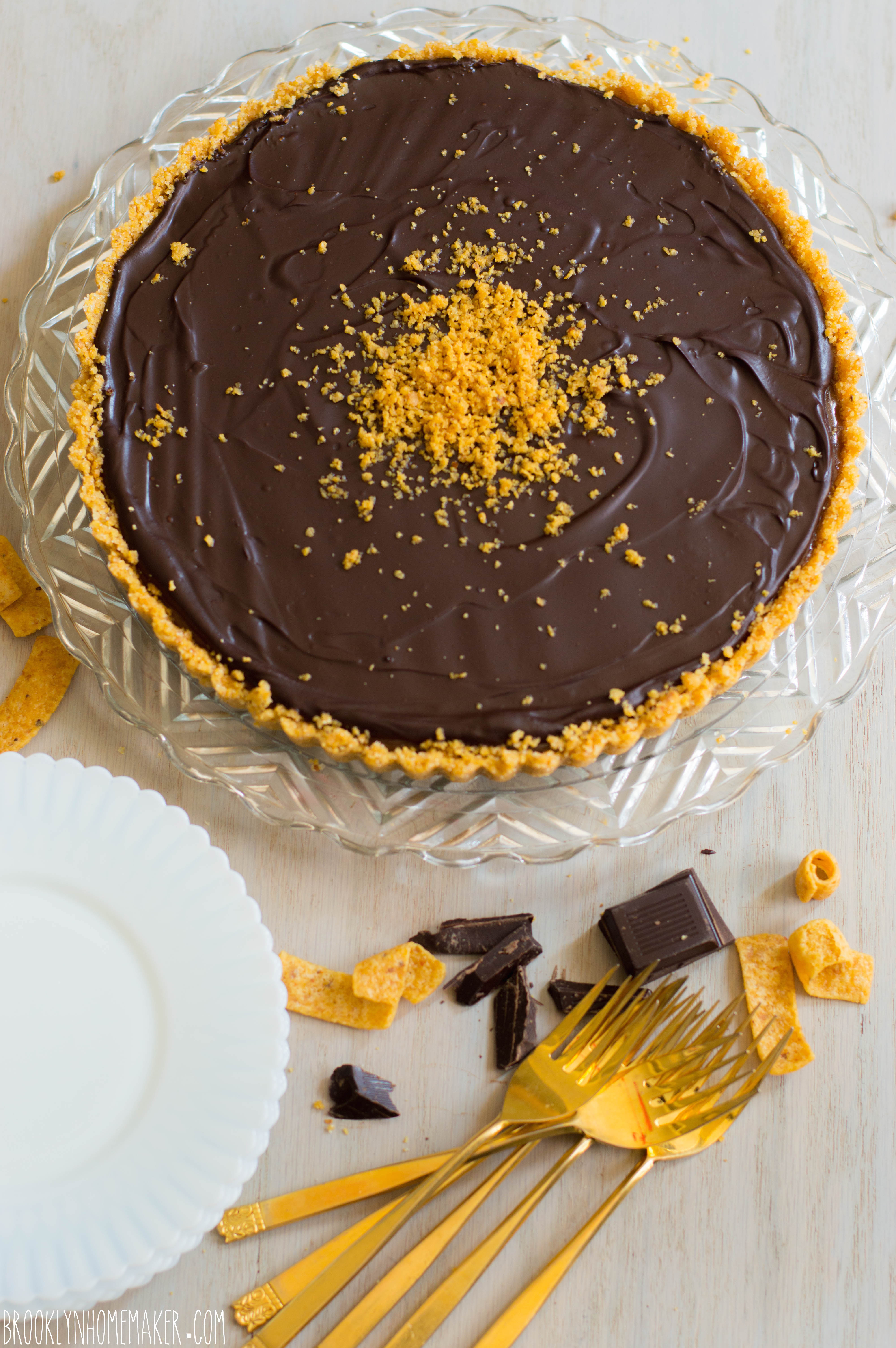
Since I can’t actually share my Ritter Sport bounty with all of you, I thought I’d do the next best thing. The next best thing being the creation of a gussied up version of a candy bar, in fancy pants tart form.

The tortilla chip crumbles in the candy bar seem thicker and crunchier and somehow “cornier” than a normal tortilla chip, and to me at least, taste almost like Fritos. Nothing wrong with that.

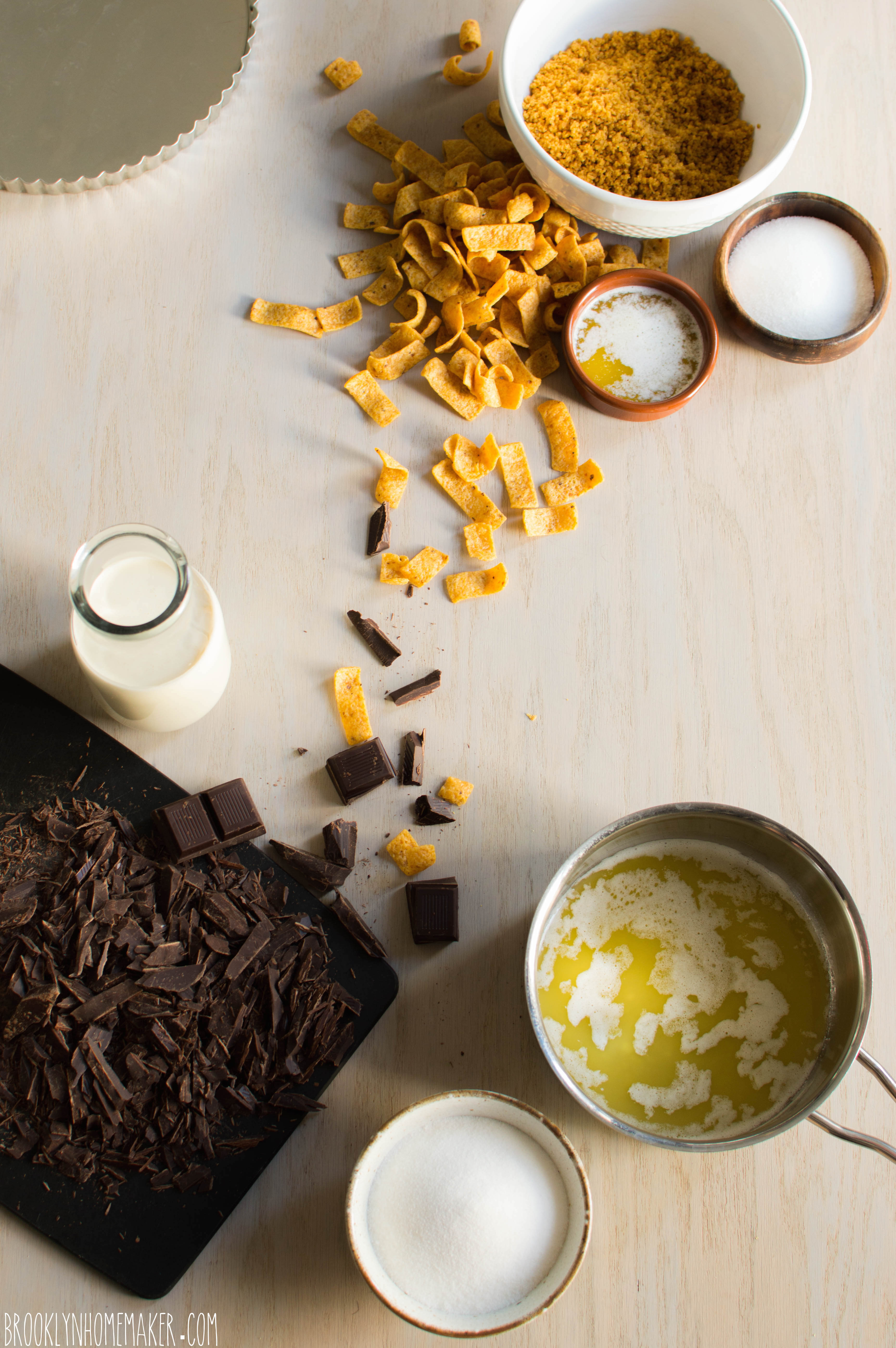
So, in a moment of genius-level perfect clarity, I decided to crush up Fritos in a food processor and use them in the same way you would graham cracker or cookie crumbs in a pie crust. Just add butter and sugar and bake.
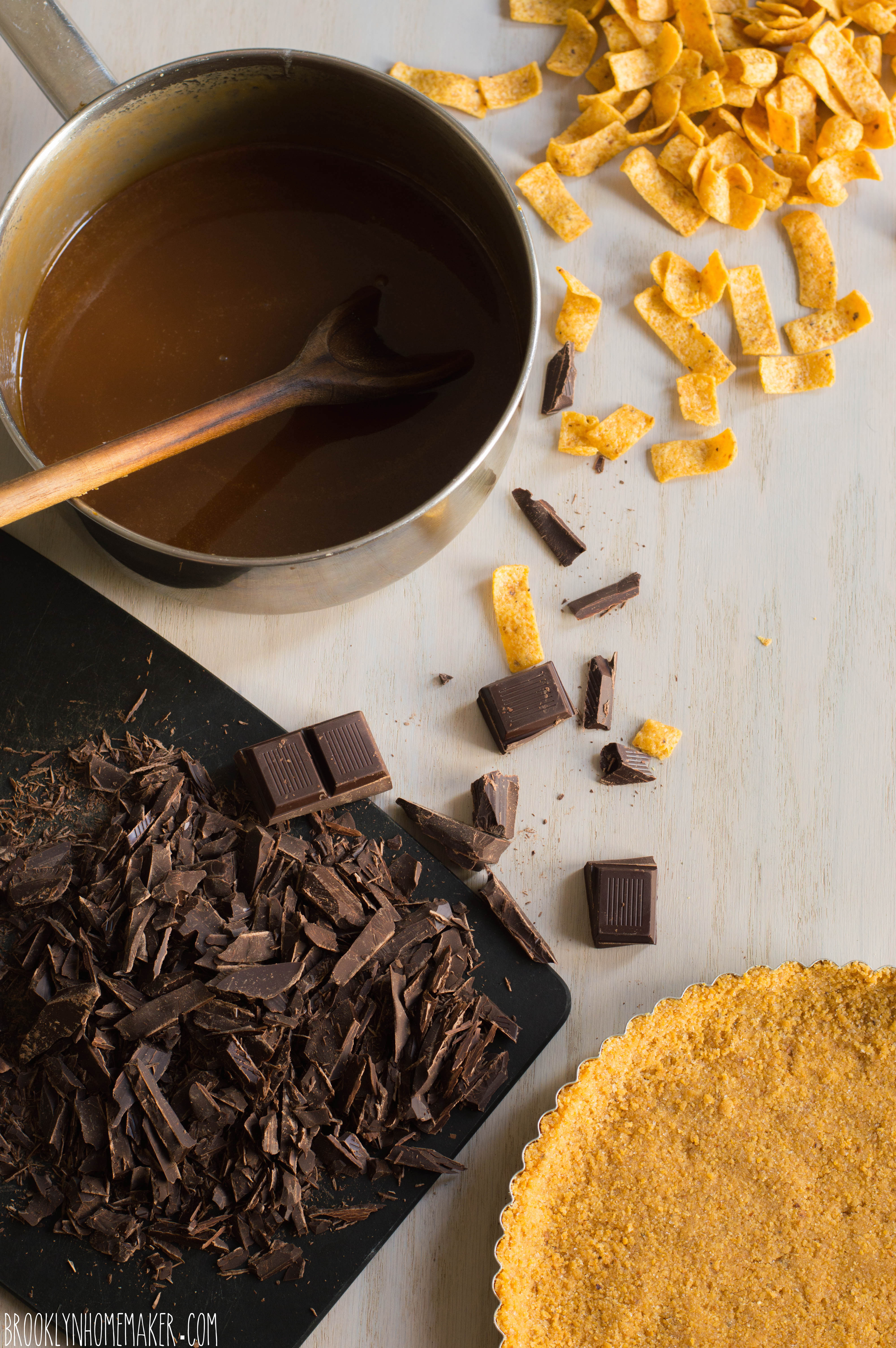
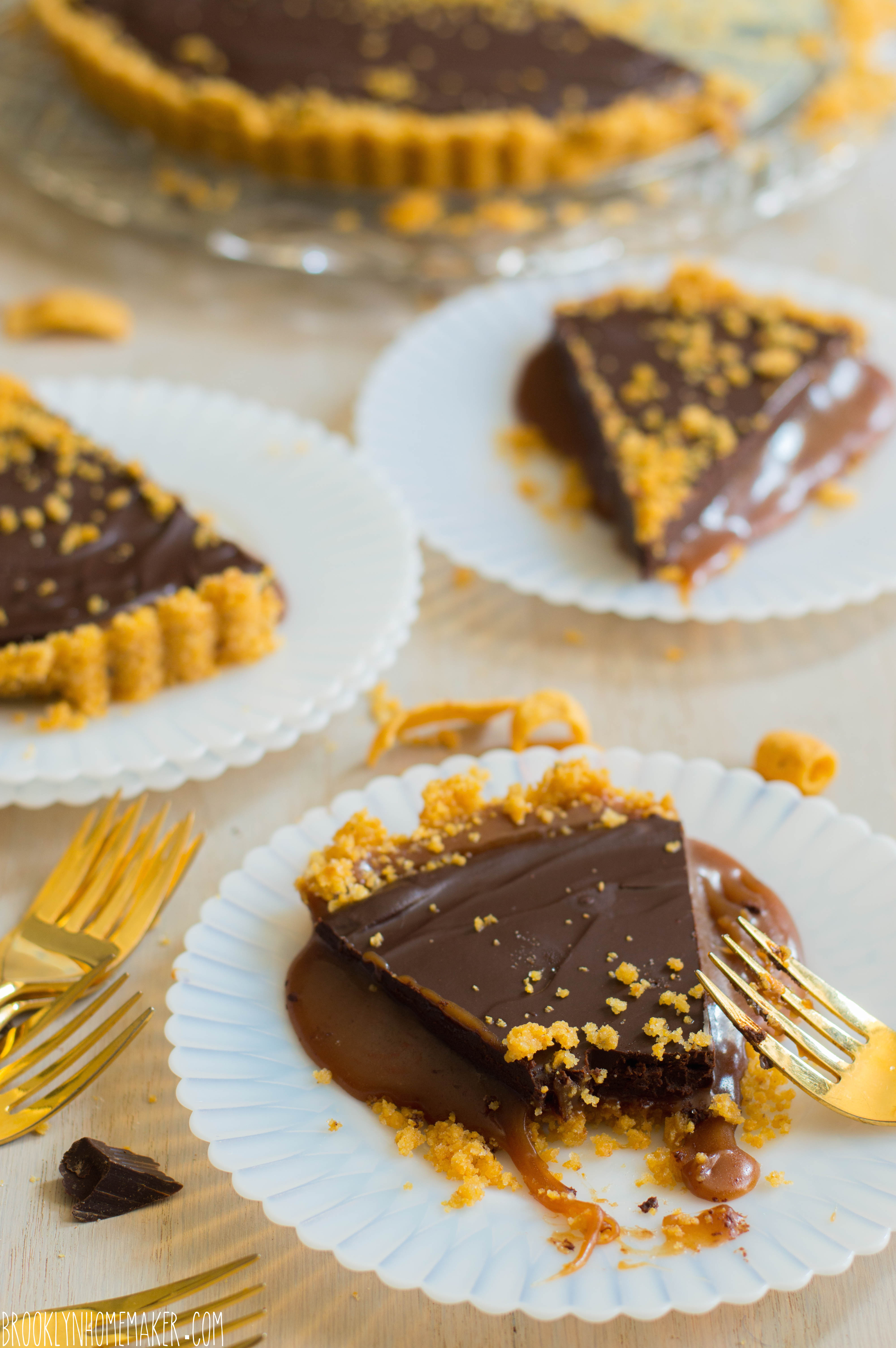
Rather than just filling the shell with chocolate, I decided to take it one step further and add a layer of sweet gooey buttery caramel too, and then cover that with heavenly rich dark chocolate ganache.

If you dig the sweet and salty chocolate thing, you have to try this. You can thank me later.

chocolate caramel frito tart | Brooklyn Homemaker

Chocolate Caramel Frito Tart

Adapted from Brown Eyed Baker

Frito crust:
1 1/4 Fritos corn chip crumbs (from about 3 to 3 1/2 cups chips)
4 tablespoons melted unsalted butter
1/4 cup granulated sugar

Caramel Filling:
3/4 cup heavy cream
6 tablespoons unsalted butter
1 1/2 cups sugar
1/2 cup water
1 teaspoon vanilla extract
1/4 teaspoon salt

Chocolate Ganache:
1/2 cup heavy cream
5 ounces dark chocolate, finely chopped

Crust:
Preheat oven to 350 degrees F.
Place about 3 to 3 1/2 cups of Fritos corn chips in a food processor or blender and pulse into fine crumbs. You could also use a ziplock bag and a rolling pin in a pinch. Save a tablespoon or two for garnish if you have any leftover.
Measure out 1 1/4 cups of crumbs and transfer to a bowl. Add melted butter and sugar and stir until butter is evenly distributed throughout mixture. Transfer crumbs to a 9″ tart pan, ideally one with a removable bottom, and evenly press the crumb mixture into the bottom of the pan and up the sides to form a crust.
Bake for 15 minutes, or until it smells toasty and just barely begins to brown. Remove from oven and set aside to cool.

Caramel Filling:
Heat the butter and cream together in a small saucepan (or in the microwave) just until the butter has melted. Set aside.

In a separate medium saucepan, combine the sugar and water over low heat, stirring until the sugar has completely dissolved. Increase the heat to high and boil, without stirring, until it reaches a deep golden amber (340 on a candy thermometer, but I just went by color). Once it starts to brown watch it carefully. If it gets too dark it will turn bitter.
Remove from the heat and slowly stir in the cream mixture (It will bubble up a lot, be careful!). Return the pan to low heat and cook, stirring constantly, for about 5 minutes or until thickened. Stir in the vanilla and salt, and then pour caramel into the crust.
Refrigerate until firmly set, at least 30 minutes.

Chocolate Ganache:
Place the chopped chocolate in a heat proof bowl. Heat the cream in a small saucepan over medium heat until it begins to simmer. Pour hot cream directly over the chocolate. Let it sit for 2 minutes, then stir until the chocolate is completely melted and smooth. Pour the chocolate over the firmly set caramel layer and spread smooth. Sprinkle with additional Fritos crumbs before transferring the tart to the refrigerator for at least 15 minutes to set up.

This tart is incredibly rich so slices should probably be on the smaller side.
Leftovers should be stored, covered, in the refrigerator for up to 5 days.

chunky beef and bean chili

Ugh this weather.

chunky beef and bean chili | Brooklyn Homemaker

Hot. Cold. Hot. Cold. Sunshine. Snowfall. Short sleeves. Heavy coats.

I know that I’ve whined about New York’s weird weather before, last week in fact, but oh lord is it annoying. I’ve lived in New York State for my entire existence so I suppose I should be used to it by now, but I’m not okay?
Every spring I get the itch to get outdoors and when that shady bitch Mother Nature dangles 70 degree temperatures in front of my face and a few days later tosses a little snow storm my way I start to get cranky.

chunky beef and bean chili | Brooklyn Homemaker

After last week’s unusual heatwave, we had snow over the weekend.

My first instinct was to stand in the window shaking my first (There may have also been a few “why I oughta”s thrown in), but I got tired (and cold) after a while so I decided to take my pity party into the kitchen and see what I could do to make myself feel better.

chunky beef and bean chili | Brooklyn Homemaker

Full disclosure:
I’ve posted this recipe, or at least a version of it, before.

This is one of my absolute favorite cold weather recipes and I’ve made it countless times since I first posted it. Since then I’ve made some changes to streamline some steps and make a few little improvements.

chunky beef and bean chili | Brooklyn Homemaker

Another moment of full disclosure:
I like my chili with big chunks of meat, a bit like a stew, rather than ground beef.
I also like lots of beans in my chili.

I realize my Texas friends are probably rolling their eyes and/or recoiling in horror right about now, but I’m a Northeasterner through and through. This is not “Texas Chili” and I make no qualms about this being an “authentic” recipe.

This is just how I like it. It’s freaking delicious. So deal with it.

chunky beef and bean chili | Brooklyn Homemaker

There’s a very good reason that I wanted to try this chili again and re-post the recipe for you. A while back I read an article on thekitchn that said a great way to ensure tender slow cooked meat in stew is to wait a bit before adding acidic ingredients like wine or tomatoes. While acidic ingredients can help tenderize meats in marinades, they can have the opposite effect and actually prevent or prolong tenderizing in braised dishes. Instead, they suggest that you make your stew (or chili in this case) without the acid, let the meat loosen up and get a head start on tenderization, and then add your acidic ingredients and continue to cook just long enough that they no longer taste “raw”.

I said before that I’ve made this recipe countless times with countless variations, but as soon as I read this tip I just had to try it with my chili. I gave it a go and was floored by how well it came out so I HAD to share the results with y’all.

chunky beef and bean chili | Brooklyn Homemaker

Okay one last bit of full disclosure:
I’m a big fan of heat and bold flavors so I tend to go a little overboard with the jalapeños, cayenne, and chili powder.

In the recipe below, the ingredients listed have ranges for those three ingredients. When making this for myself I used the maximum amount of spice listed on all three counts and I thought it was absolutely perfect. Russell however, complained (multiple times) that it was too spicy and said that I should reduce the heat for y’all.
So, if you like the heat feel free to go crazy and use the full amounts listed below. If you like things on the milder side, use caution and stick to the minimums. If you’re somewhere in between, stay somewhere in between.

When it comes to the meat, I usually like to buy a small chuck roast and cut it up into chunks myself. I find that A) this method is cheaper, and B) I know exactly what cut of meat I’m getting rather than the “grab bag” of leftovers they package as stew meat at the grocery store. I also find that the stew meat at my local grocery stores is usually cut too large to actually eat in one bite, and I always need to cut it up smaller myself anyway.

chunky beef and bean chili | Brooklyn Homemaker

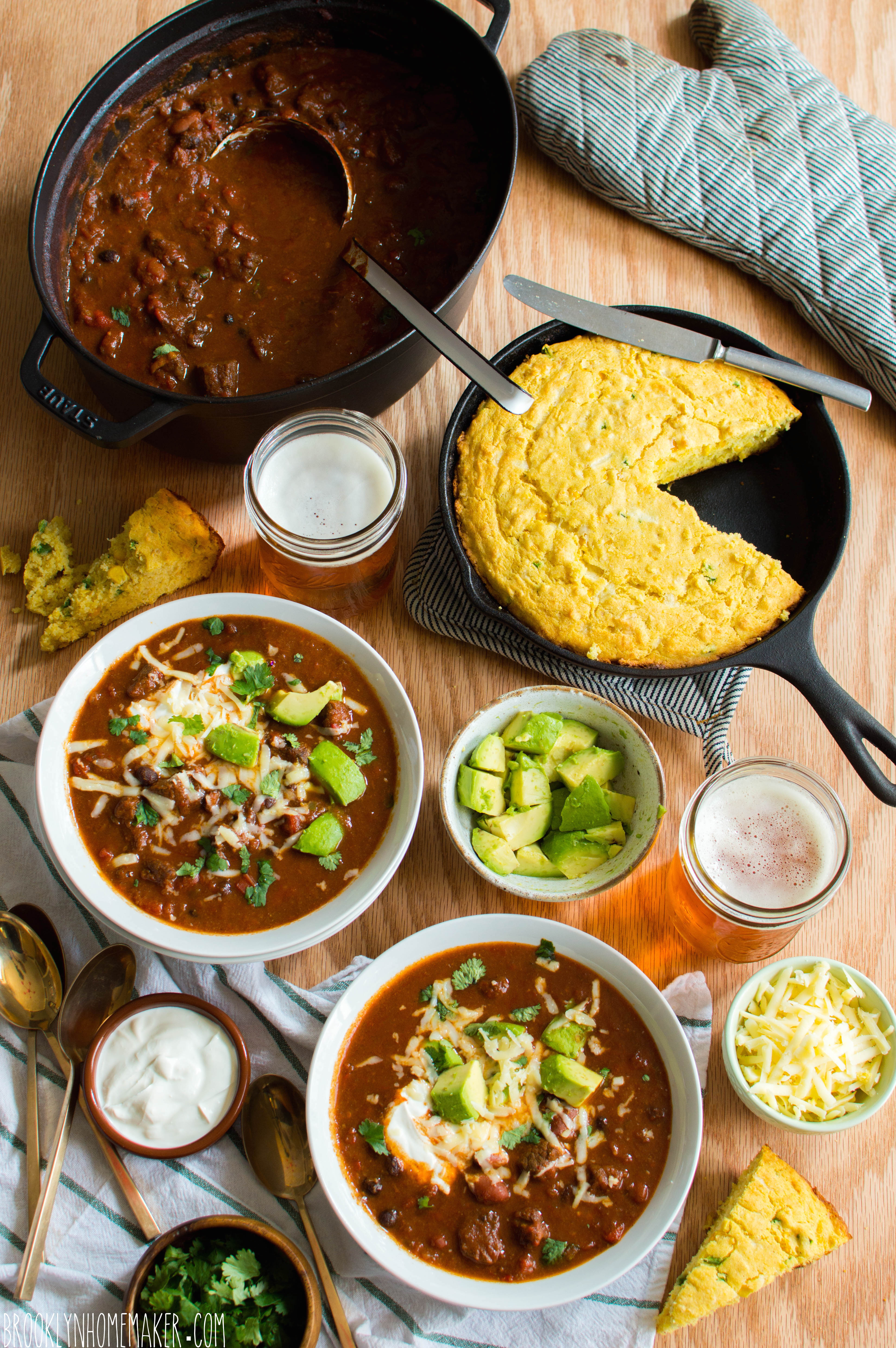
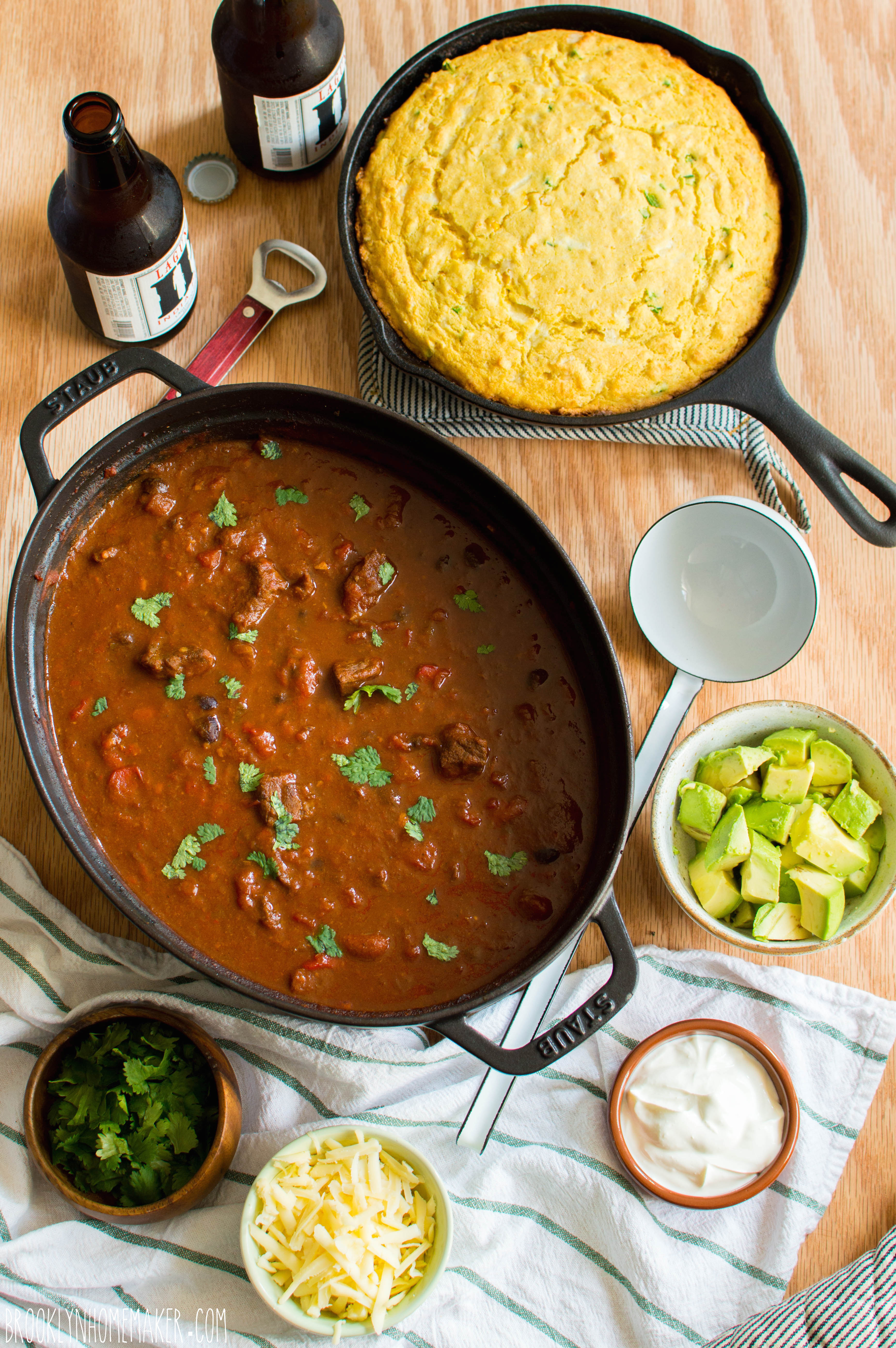
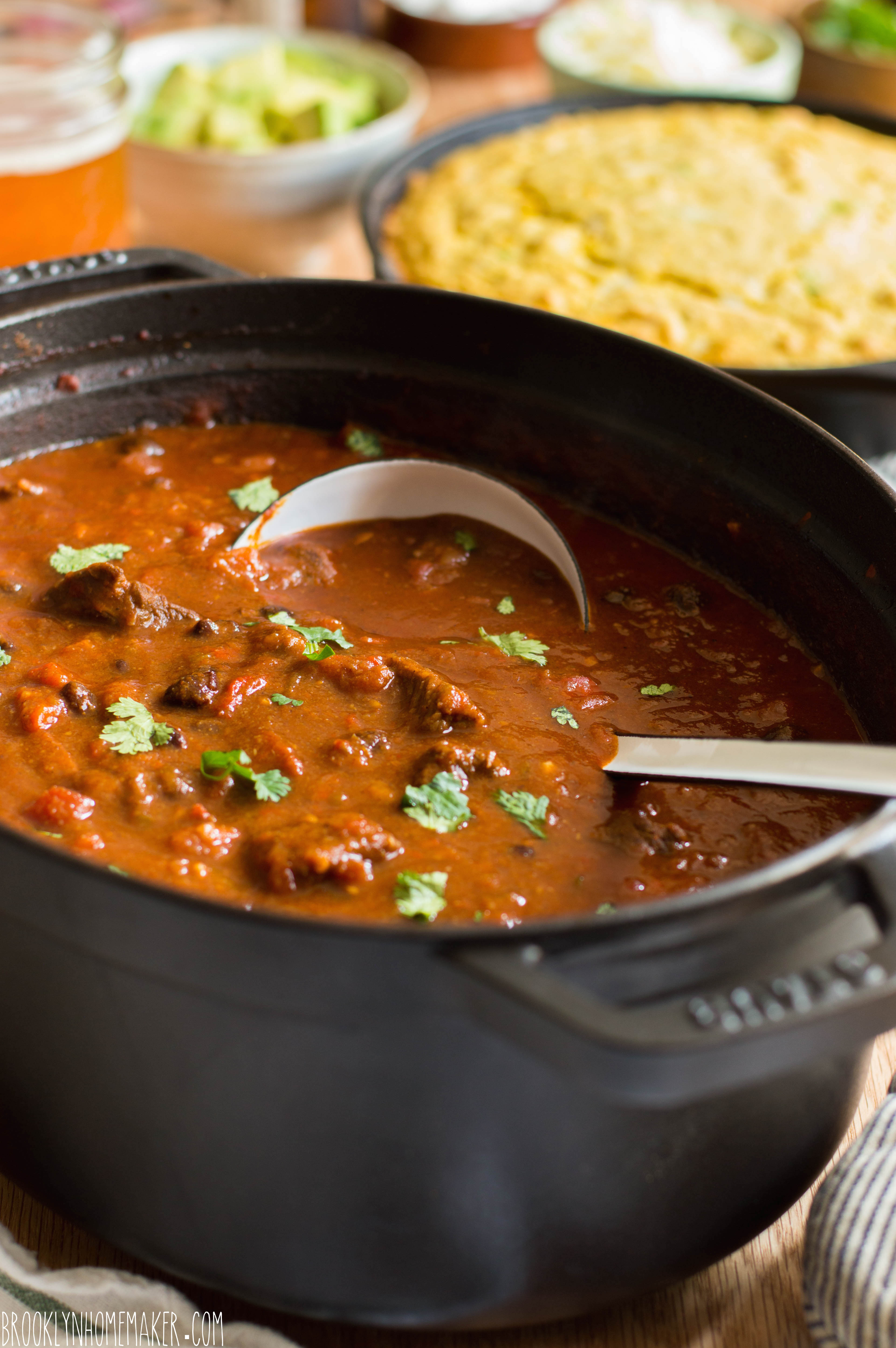
Either way you go, this chili is insanely good. Thick and rich and tomatoey with a great flavor and as much heat as you like. Fall-apart tender chunks of beef mixed with hearty veggies and plenty of beans make this chili feel incredibly hearty and filling. Perfect for a chilly spring day.

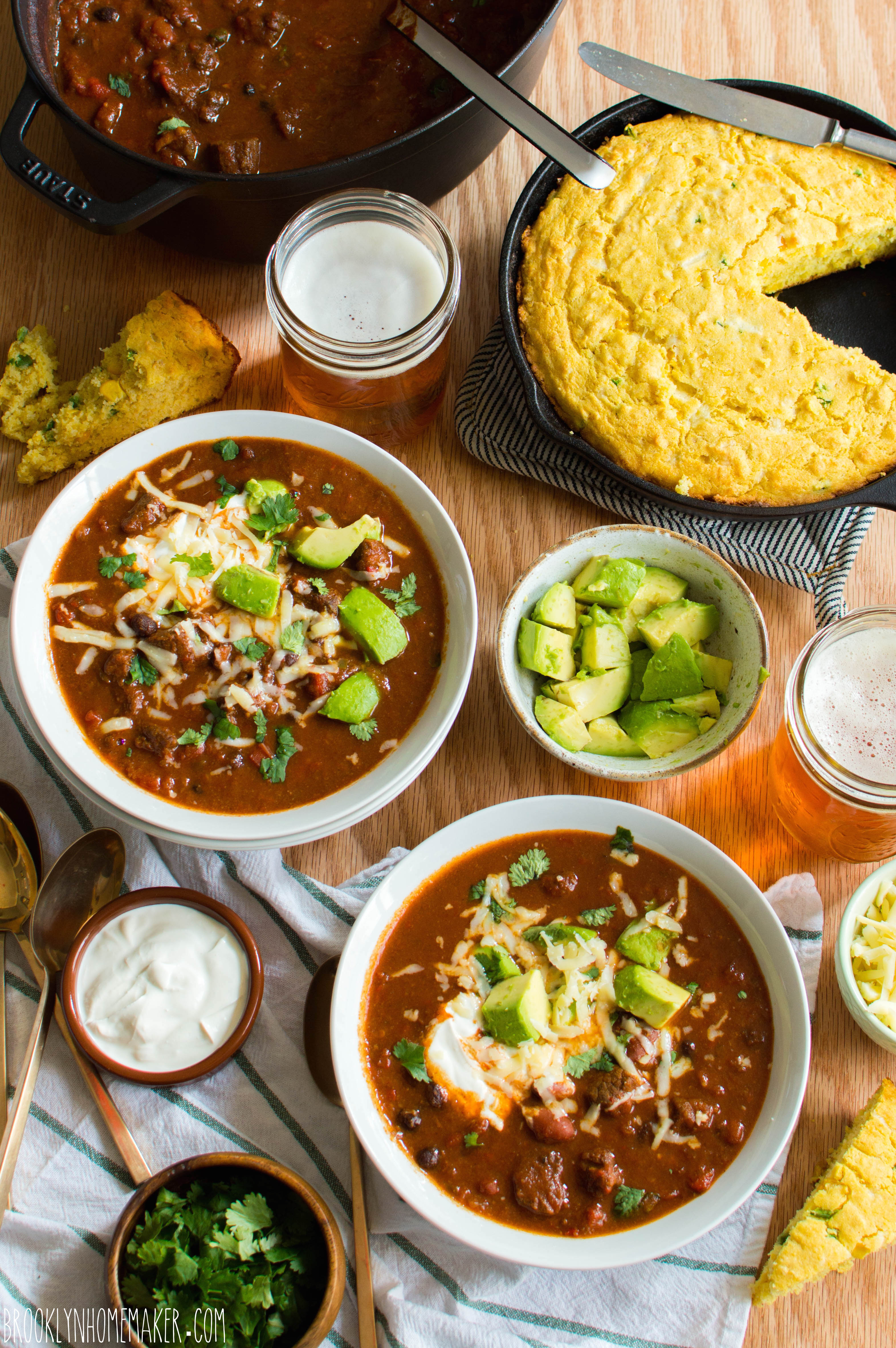
If you do go a little overboard with the spice, a heaping dollop of sour cream, a handful of grated cheddar, and some rich and creamy sliced avocado can go a long way to tame that heat.

chunky beef and bean chili | Brooklyn Homemaker

adapted from my own recipe

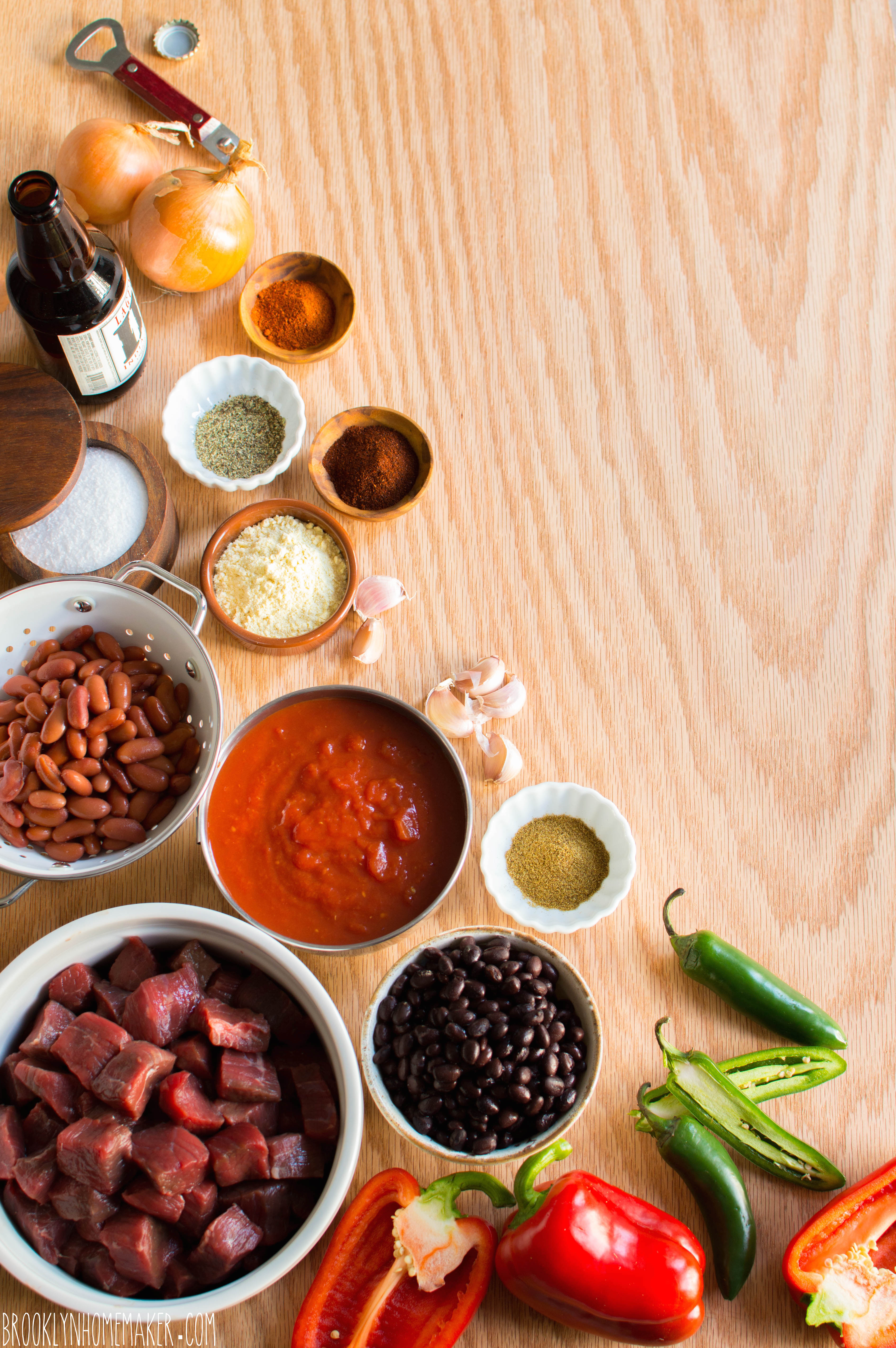
2 to 3 tablespoons olive oil, divided
3 pounds beef chuck or beef stew meat, cut into 1″ cubes
2 tablespoons masa corn flour (or all-purpose)
1 1/2 teaspoons coarse Kosher salt (maybe more as necessary)
1 1/2 teaspoons freshly ground black pepper (maybe more as necessary)
1/4 to 1 teaspoon cayenne pepper (depending on how spicy you like it)
2 teaspoons ground cumin
1 to 1 1/2 tablespoons chili powder
1 1/4 cup good Ale or dark beer, divided
2 medium onions, chopped
2 red bell peppers, seeded and coarsely chopped
1 to 2 jalapenos, seeded and finely diced (depending on how spicy you like it)
5 to 6 cloves garlic, finely chopped or crushed
3 cups beef stock
28 oz  can crushed tomatoes
1/4 cup tomato paste
15 oz can red kidney beans
15 oz can black beans

Optional garnishes:
grated cheddar cheese
sour cream
torn cilantro leaves
sliced avocado

If using pre-cut stew meat, you may need to cut it smaller to get 1″ pieces. Toss beef in salt, pepper, cayenne, cumin, chili powder, & masa to evenly coat.
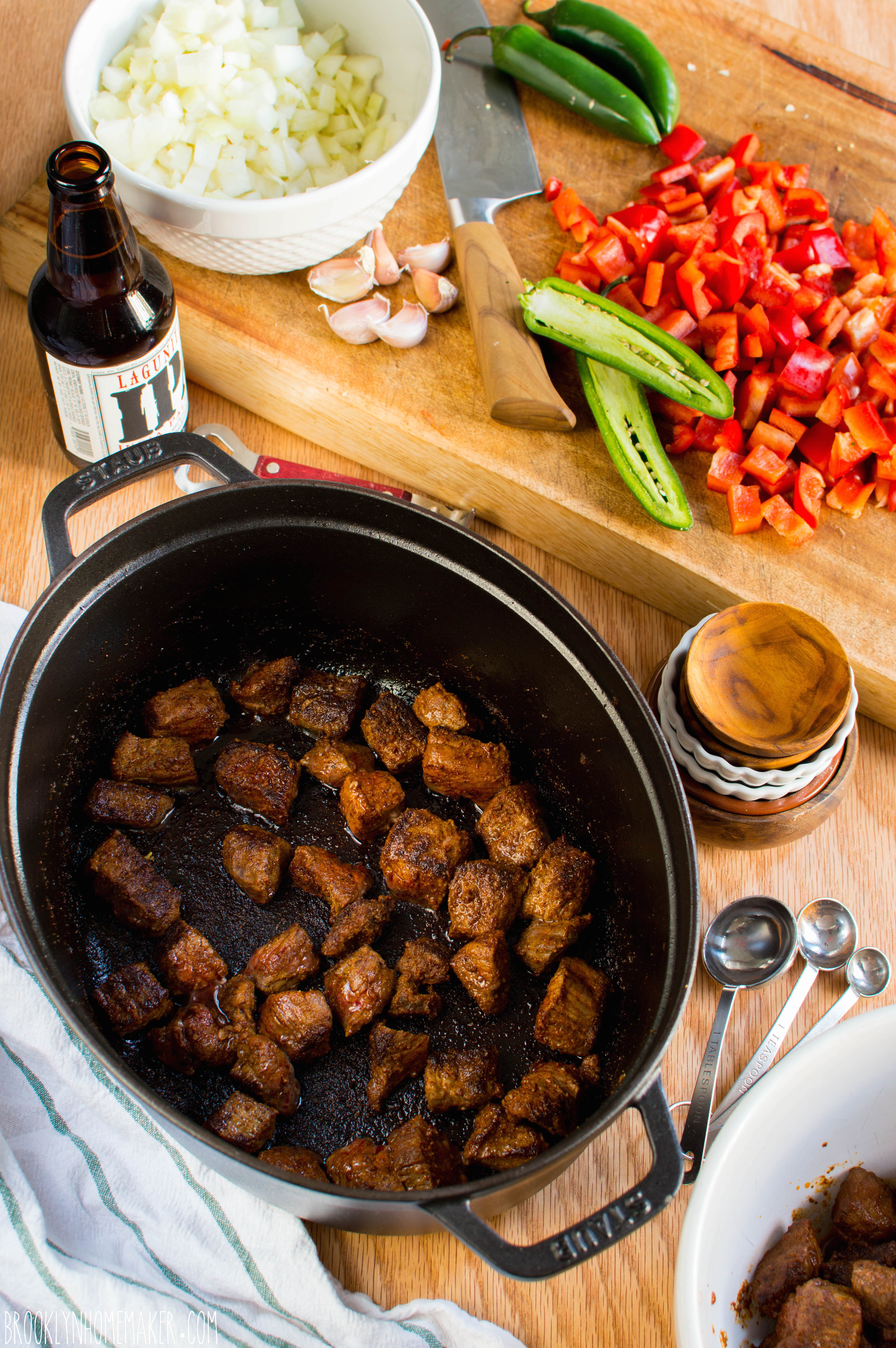
In a large heavy bottom dutch oven or stockpot, heat about 1 tablespoon of the olive oil. Brown the meat in batches for 5 to 6 minutes, turning each piece about half way through to brown multiple sides. Do not overcrowd the pan or the meat will steam, not brown. Transfer browned beef to a bowl to rest while you brown the next batch, and repeat until all meat is browned. Add more oil between batches if necessary.

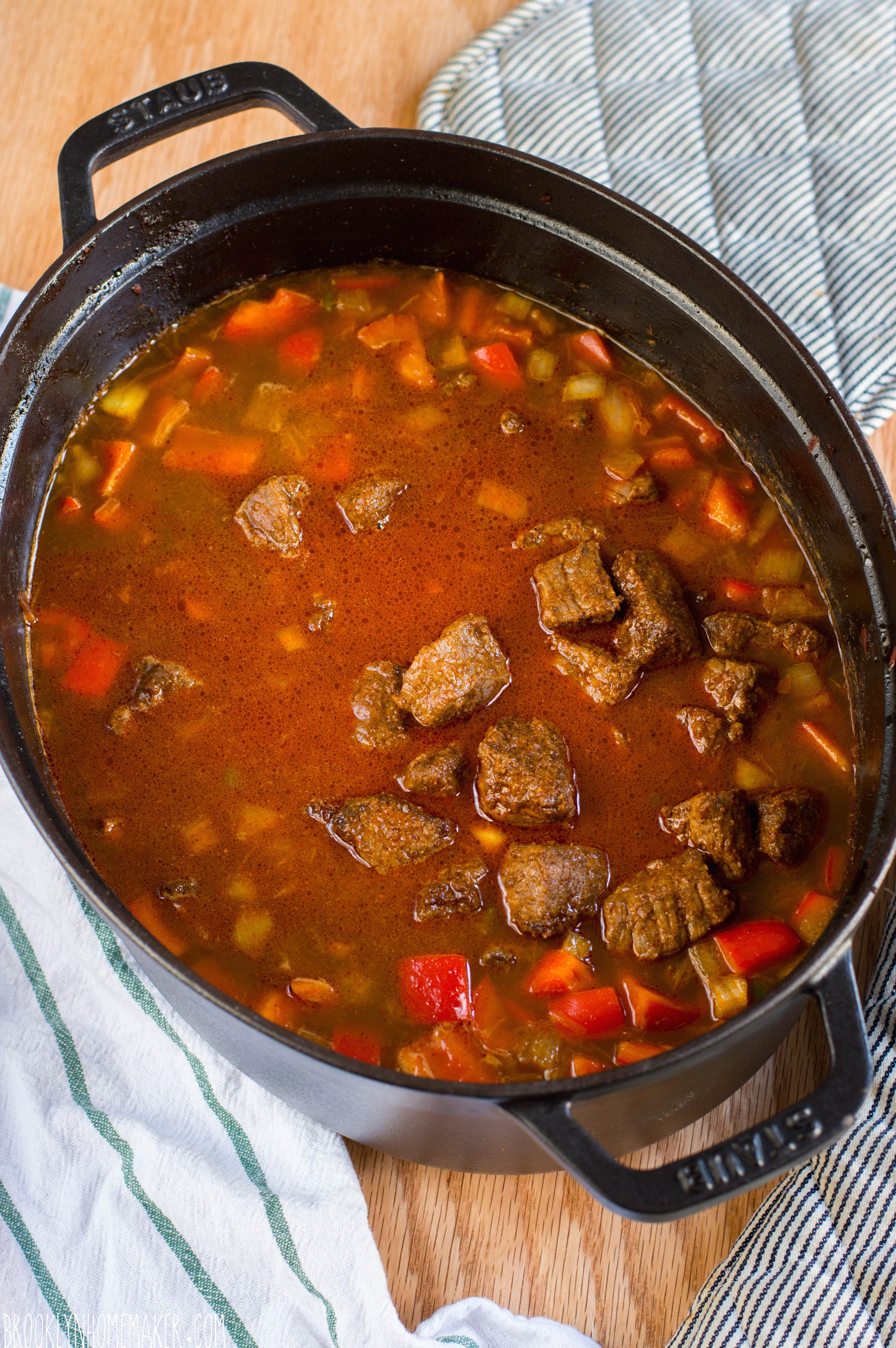
Once you’ve removed the last batch of meat, deglaze the pan with about 1/4 cup of the beer. Scrape up any stuck bits off the bottom of the pan with a wooden spoon. Reduce beer to almost dry. Add another tablespoon of oil and, once the oil is hot, sauté the onions for a minute or two. Add bell peppers, jalapeños, and garlic and cook 3 to 4 minutes more. Add beef stock, remaining beer, and browned beef cubes to the pan and bring to a simmer. Cover and simmer for one and a half hours, stirring occasionally. Uncover and simmer for one half hour more. Stir in crushed tomatoes, tomato paste, and beans. Continue to simmer uncovered for at least 30 minutes more or until the beef is fork tender and the liquid is slightly reduced and nicely thickened.
Taste and re-season with salt and pepper if necessary. If the chili is too thin, continue to simmer uncovered until it’s thick enough. If too thick, thin it out with additional beef stock, about 1/4 cup at a time.

Garnish with grated cheese, sour cream, torn cilantro leaves, and/or avocado. Serve with warm cornbread if desired.

drømmekage (Danish dream cake) bundt cake #bundtbakers

Are you guys as ready for summer as I am?

drømmekage (danish dream cake) bundt cake | Brooklyn Homemaker

Are you ready for sunny days and warm weather? Ready to feel the warmth of sunshine on your skin? Ready to walk outdoors in short sleeves and single layers of thin cotton clothing?

I’m not afraid to admit that I am. I am 100% ready. I’m also, officially, over this winter.

drømmekage (danish dream cake) bundt cake | Brooklyn Homemaker

Up until this point I’ve been doing just fine. Really I have!
Here in the Northeast this winter has been totally mild and easily tolerated. At least it was until last week, when shady ol’ Mother Nature decided it would might great fun to give us a little taste of what we’ve been missing.

For three glorious days, temperatures were suddenly in the mid-70s during the day, with ample sunshine, warm breezes, and the smells of spring air. Record breaking warmth for this time of year. Easily deceived by Mother Nature’s dirty tricks, I started planning barbecues and garden parties.

Our false summer was fleeting though, and disappeared behind some rain clouds as suddenly as it arrived, leaving us to close the windows again and turn the heat back up.

drømmekage (danish dream cake) bundt cake | Brooklyn Homemaker

Luckily, Christiane from Taking on Magazines chose “Tropical Vacation” as our theme for the bundt bakers this month. What better way to delude myself into thinking it’s warm and bright and wonderful outside when you and I both know that it isn’t?

If you’re as hungry (pun very much intended) as I am for some tropical distraction, please be absolutely certain that you scroll down past the recipe and see all the bright & tropical bundts that everyone came up with this month!

drømmekage (danish dream cake) bundt cake | Brooklyn Homemaker

Oddly enough, I’ve never really been a huge fan of most tropical fruits. For whatever reason, I prefer my produce from more temperate climates. Maybe it’s because my family comes from sturdy cold-weather Bavarian German stock, maybe it’s because my grandfather spoiled me with all of his fruit trees and garden fresh berries, or maybe it’s just because I’m a creature of habit and prefer what I’m familiar with. Who knows?
Either way, given a choice between an apple or a mango, a pear or a papaya, a peach or a pineapple, 9 times out of 10 I’m going to choose the option that grows right here in the Northeast, not the one grown on some faraway island under the shade of a palm tree.

drømmekage (danish dream cake) bundt cake | Brooklyn Homemaker

Coconut however, is the one exception to my aversion to tropical fruit. Ever since I was a child I’ve loved coconut, and I can remember countless fluffy white cakes covered in downy clouds of sweetened coconut flakes. I especially love coconut around Easter, when Grandma’s coconut cakes used to be made to look like cute fuzzy bunnies with licorice lips and whiskers, and candy coated eyeballs and noses.

It’s only fitting that I now have the chance to make a sensational coconut bundt cake with Easter only 10 days away.

drømmekage (danish dream cake) bundt cake | Brooklyn Homemaker

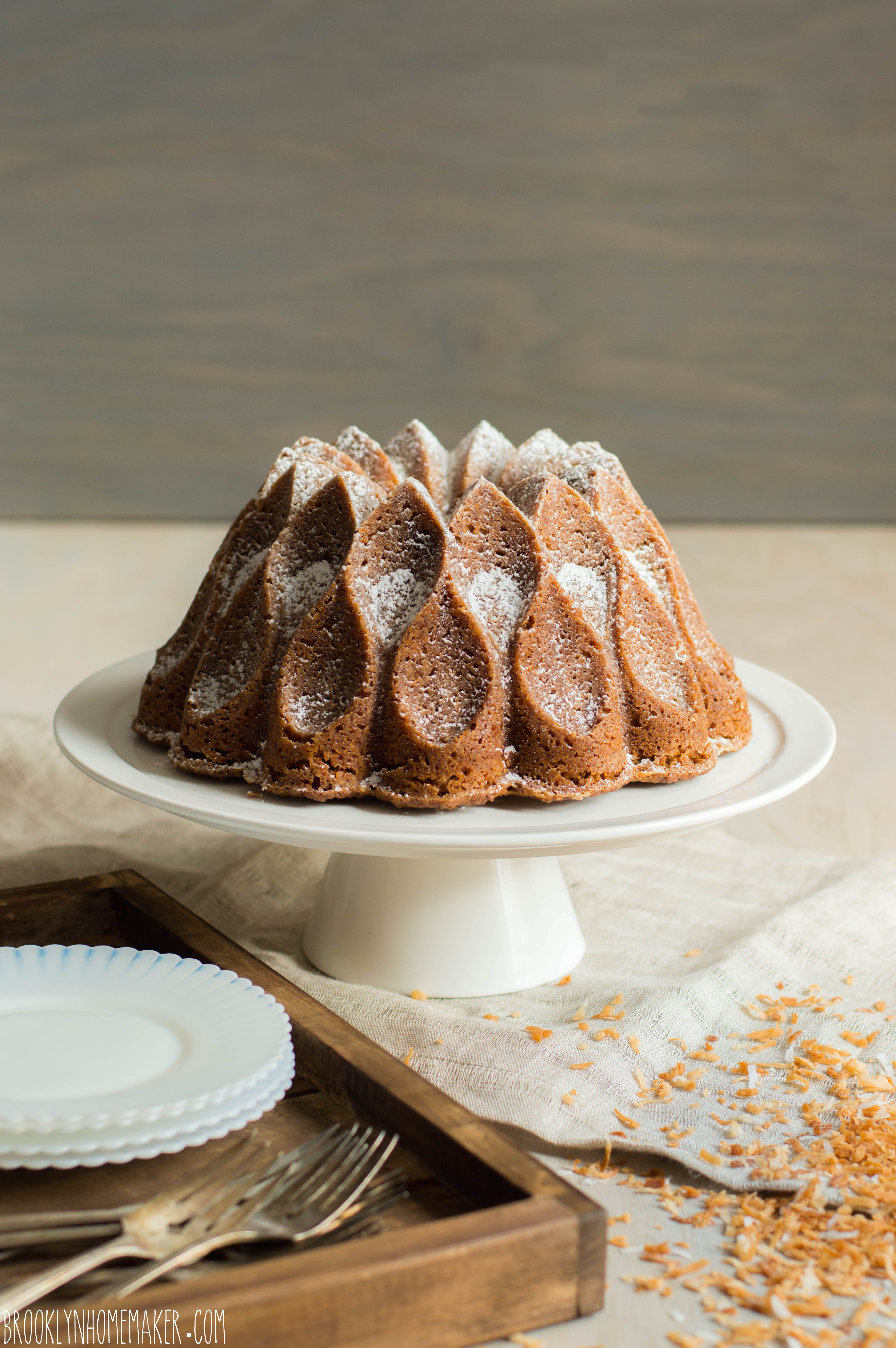
A sensational bundt cake calls for a sensational bundt pan. Luckily Nordic Ware, the company that literally invented the bundt pan, just released a gorgeous new pan to celebrate their 70th anniversary. This elegant crown shaped pan is a gold plated show stopper and features curves in all the right places! They’re truly celebrating their anniversary in style.

Nordic Ware has been making exceptional cookware and bakeware right here in the US for 70 years now, and even after all this time they’re still a family owned company. The bundt pan is by far their most famous and most popular product, and no one makes bundt pans as well as they do. Their pans are sturdy, heavy duty, ultra-non-stick, and unbelievably durable.
I should know! I put those bundt pans through more than their fair share of abuse!
I know that I’ve said this before, but as a bundt baker and bundt lover, I can’t sing enough praises for Nordic Ware’s bundt pans.

drømmekage (danish dream cake) bundt cake | Brooklyn Homemaker

I really wanted to come up with something special this month, so I was on a mission to come up with a recipe that would not only fit our tropical vacation theme, but that could also honor Nordic Ware’s Scandinavian heritage. It didn’t take me long to find a recipe for a traditional Danish cake called a Drømmekage or “Dream Cake”.

If you’re not familiar (I wasn’t), drømmekage consists of a tender vanilla cake that, after baking, is covered with a caramel and coconut topping and returned to the oven to brown up and caramelize. It certainly doesn’t get much dreamier than that!

drømmekage (danish dream cake) bundt cake | Brooklyn Homemaker

The only problem was that drømmekage is usually made as a single layer sheet cake, with the topping added only at the very end of the baking process. Since the top of a bundt cake is actually at the bottom of the pan while it bakes, I knew that converting this cake into a bundt might be challenging. I was a man on a mission though, and I was determined to make it work. I just kept telling myself, “I can bundt that.”

At first I just tried making the recipe as originally written but baking the topping into the bottom of the pan. Unfortunately the topping didn’t hold up well and got sort of rubbery when baked along with the cake for the full time, and I found the vanilla cake to be a bit bland. Next I tried simply mixing the topping ingredients together instead of cooking them into a caramel first. I just added some of the cake batter to get it all to come together. This attempt was much improved but I thought it lacked the toasty caramel flavor I was hoping for. For my third (and final) attempt I decided to toast the coconut and brown the butter before mixing it all together. I also added some vanilla bean and coconut extract to un-bland-ify the interior cake.

Third time’s a charm as they say, and this cake seriously ended up being thebomb.com. Thankfully, it was worth all the effort and recipe testing!

drømmekage (danish dream cake) bundt cake | Brooklyn Homemaker

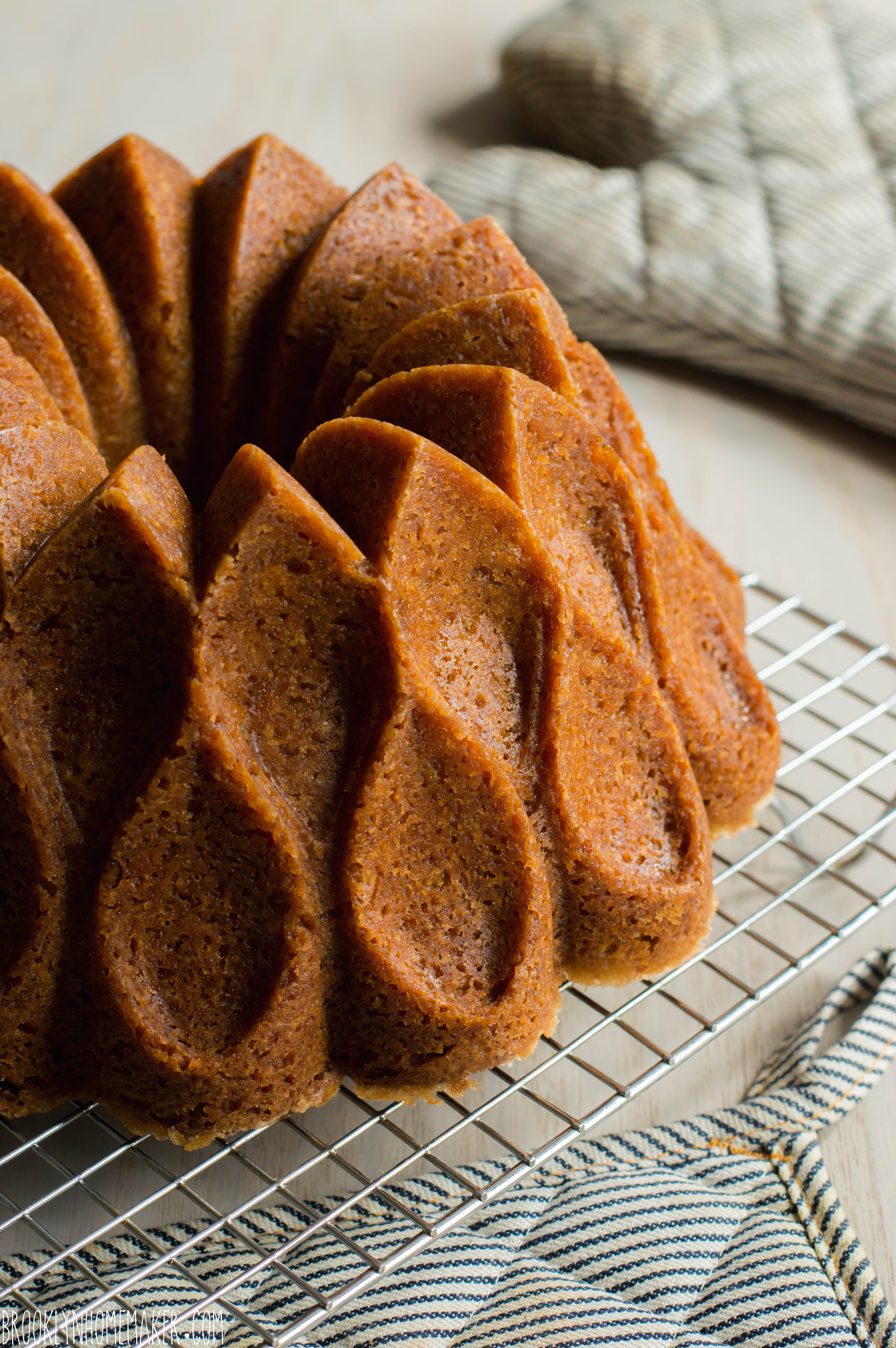
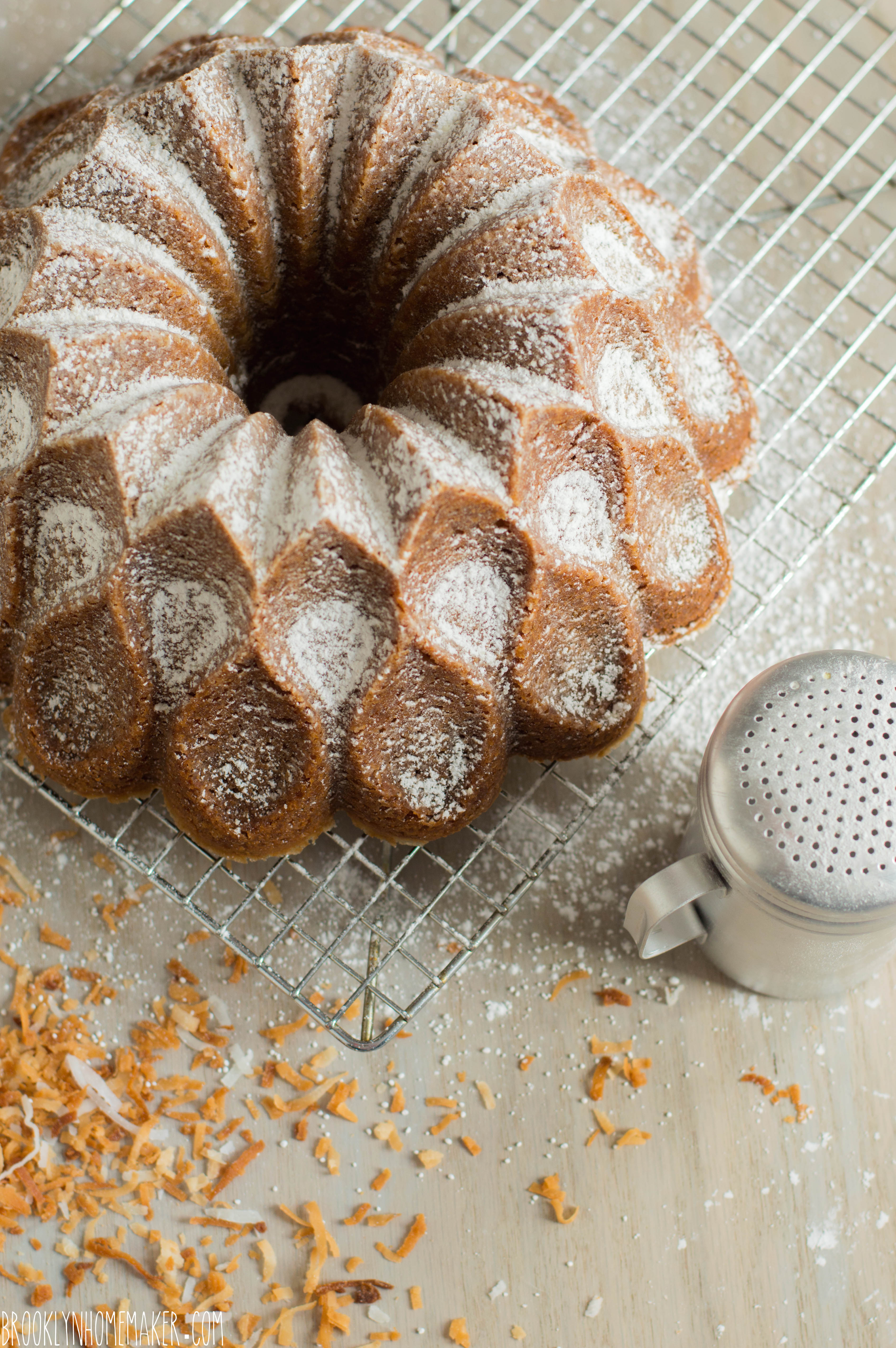
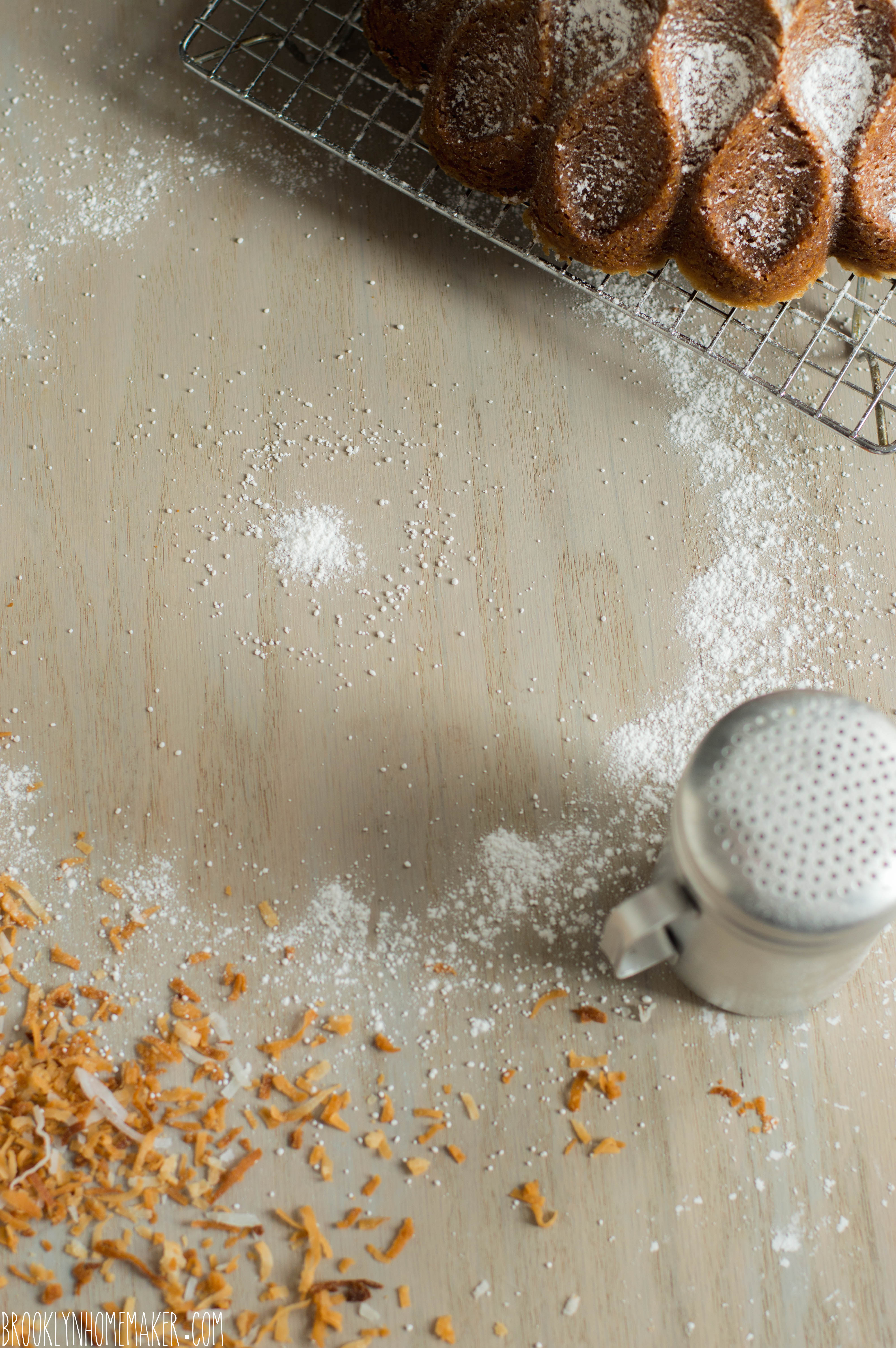
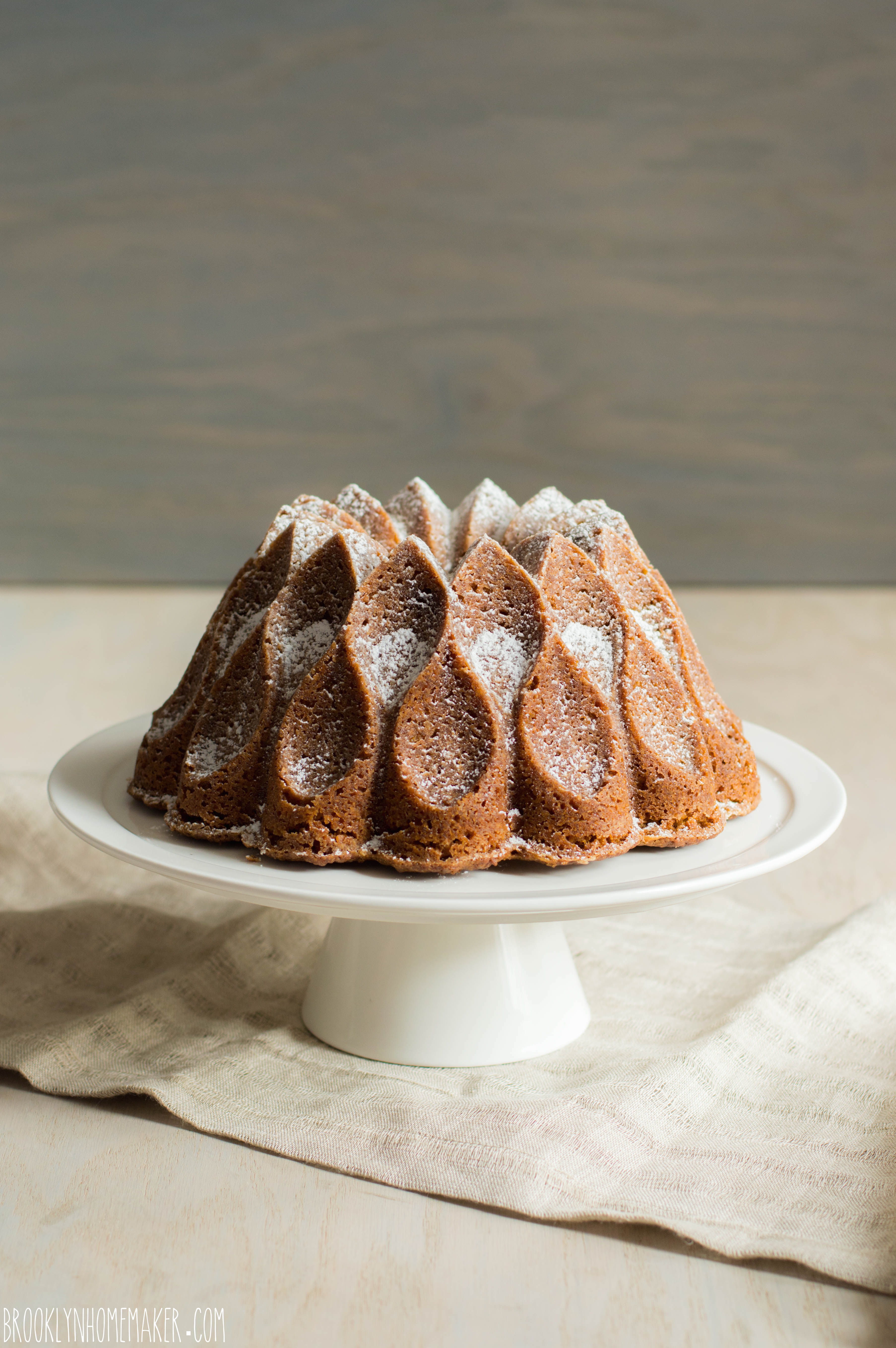
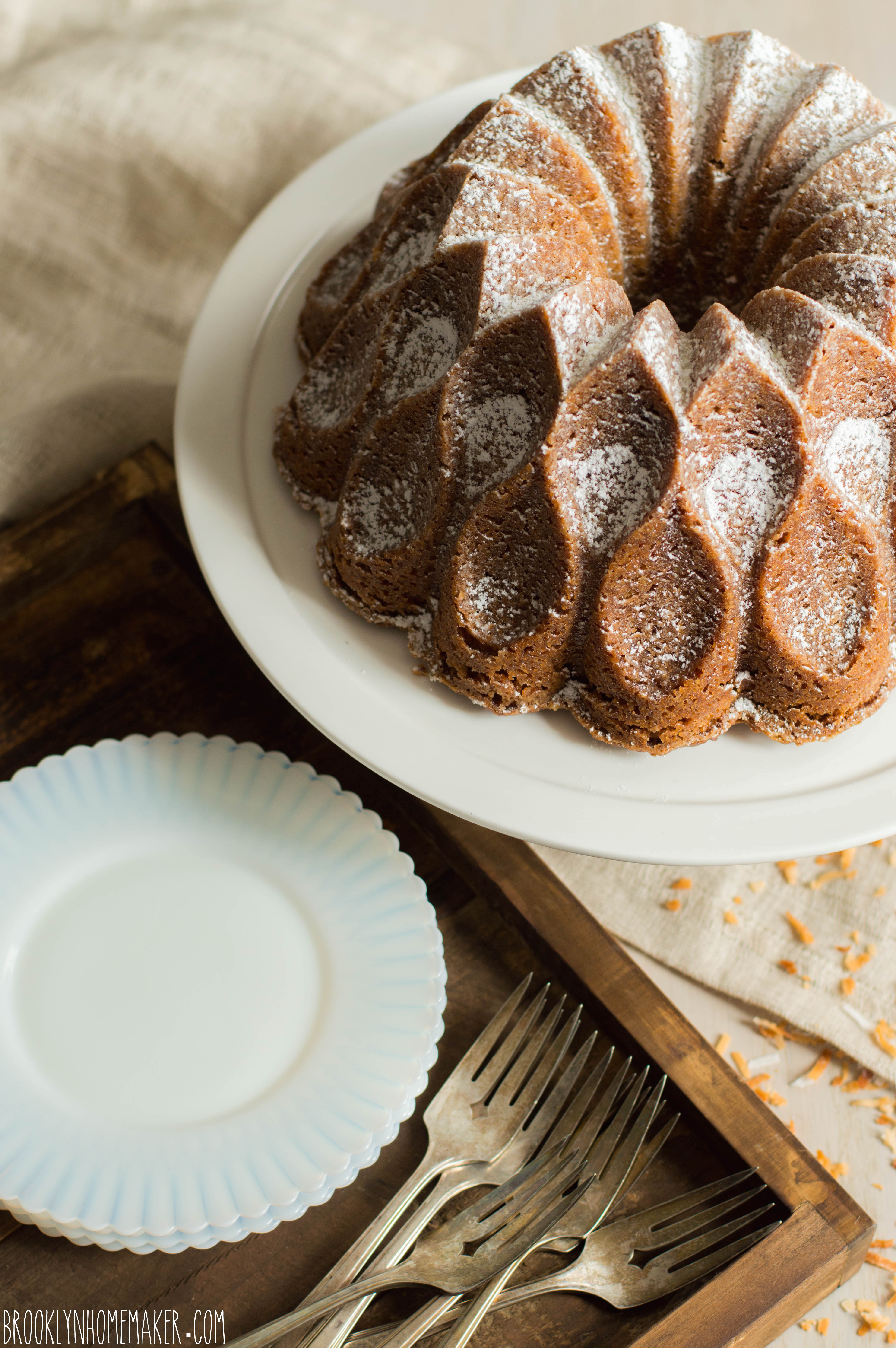
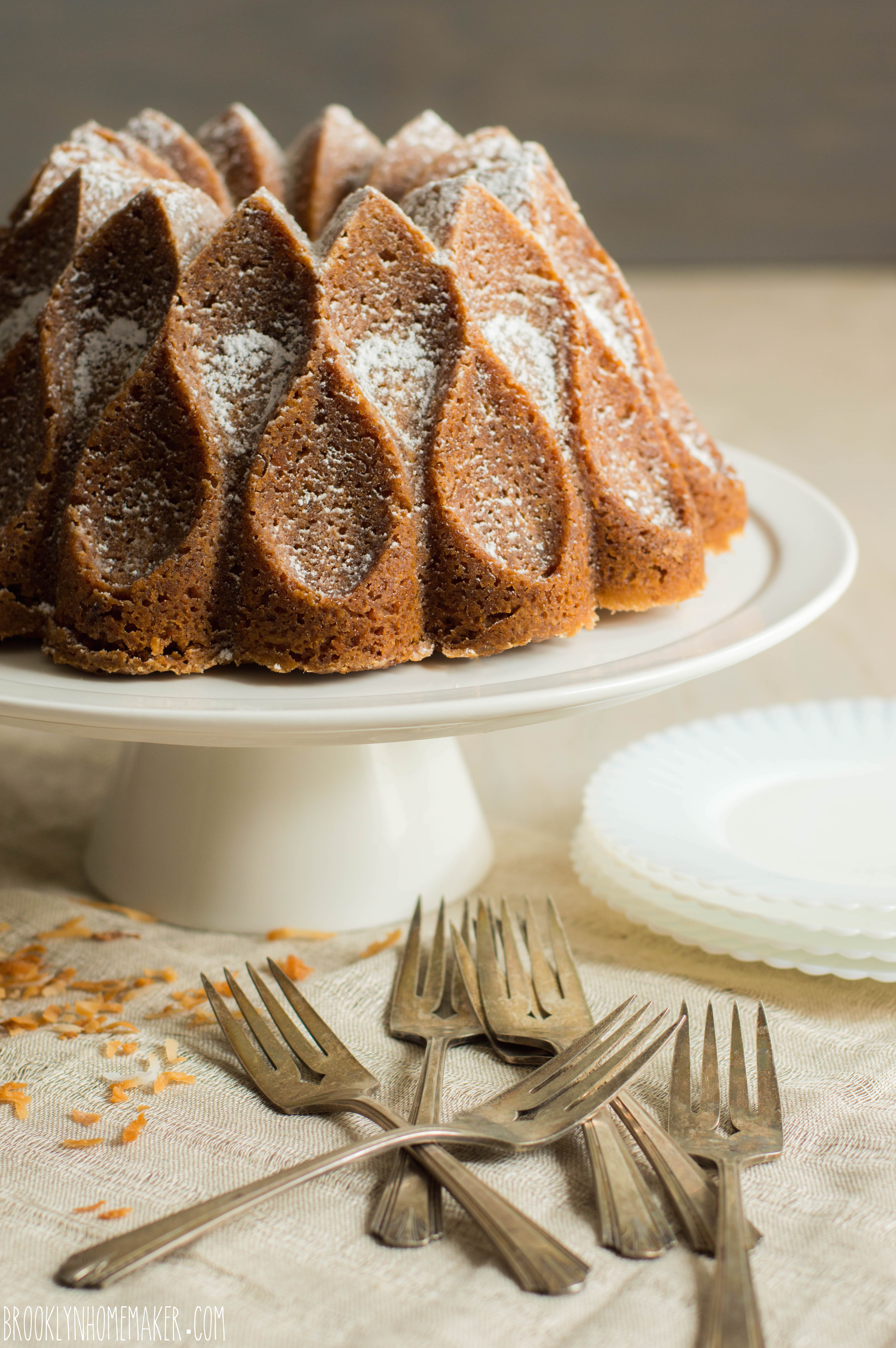
The rich brown coconut part of this cake is dense and chewy on the outer edges with a buttery and almost creamy quality on the inside. It has an amazingly rich, toasty, nutty flavor from the browned butter and toasted coconut, and a wonderful caramel flavor from the dark brown sugar. The simple vanilla cake on the interior is tender and buttery and packed with warm homey vanilla flavor.

Getting the coconut and brown sugar mixture to work as a “topping” like it would in a traditional dream cake means that you have to carefully press the mixture against the walls of the pan and make sure to push it up the sides and center tube. This can be a bit of a pain but does make for an impressive presentation. If you want to make your life a little easier though, I think it would be simpler and just as delicious if you were to combine these two batters like a marble cake instead. I’ll leave that up to you.

If you can, I recommend you try to make this cake the day before you’d like to serve it. It was amazing on the first day but I found that the texture of the coconut part had become even more tender and wonderful by the second day.

drømmekage (danish dream cake) bundt cake | Brooklyn Homemaker

Drømmekage (Danish Dream Cake) Bundt Cake

adapted from Saveur

If possible, try making this cake one day before you plan to serve it. The cake benefits from a day’s rest.

Coconut “Topping”:
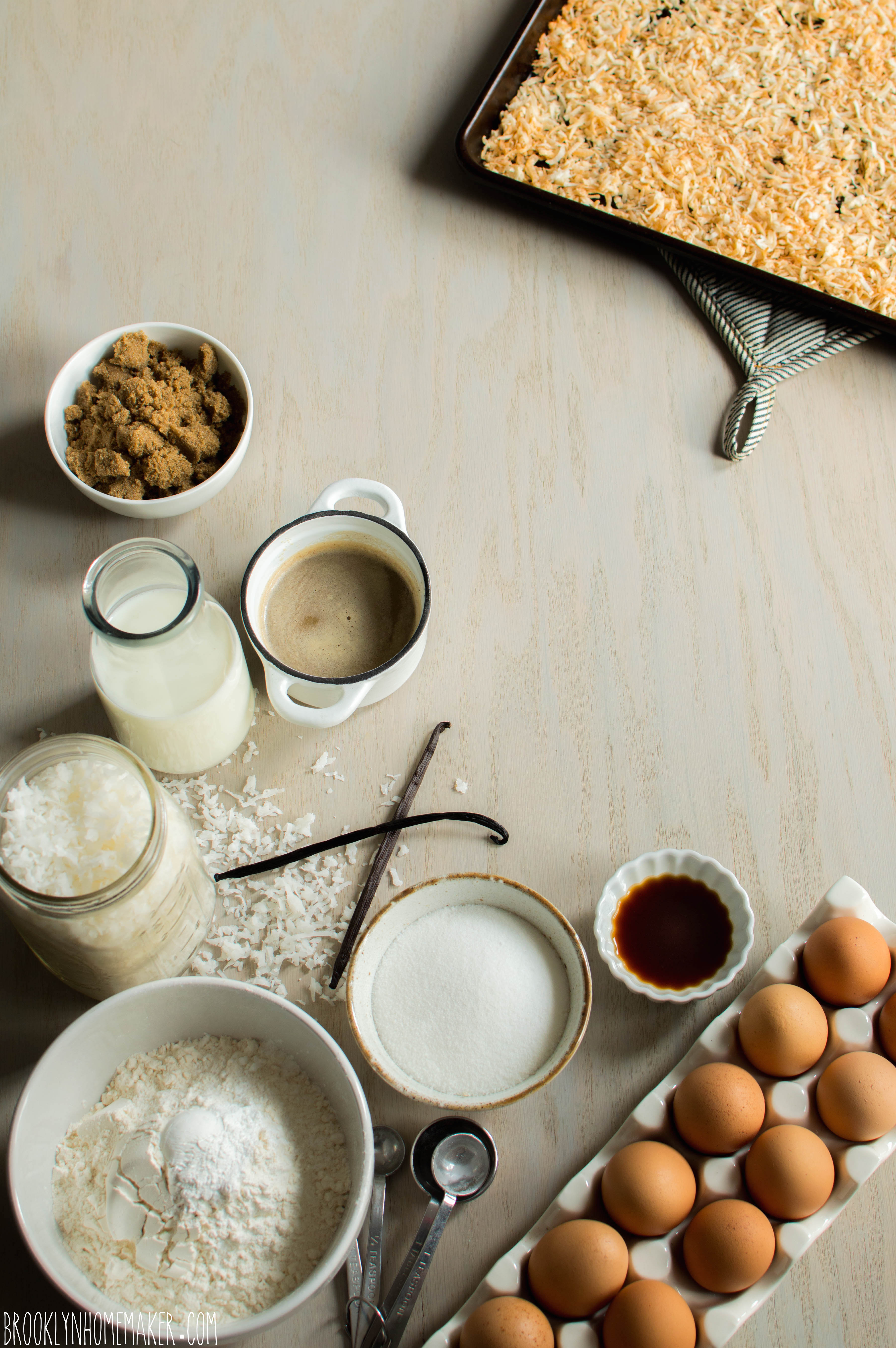
3 cups sweetened shredded coconut
8 tablespoons (1 stick) unsalted butter, plus more for pan
3/4 cup packed dark brown sugar

Cake: 
1 1/4 cups sugar
8 tablespoons (1 stick) unsalted butter, softened
1/2 vanilla bean, seeds scraped and pod discarded (or 1/2 teaspoon vanilla powder)
4 eggs
1 tablespoon vanilla extract
1 teaspoon coconut extract (optional)
2 1/2 cups all-purpose flour, plus more for pan
2 1/2 teaspoons baking powder
1 cup whole milk
1/4 cup powdered sugar for dusting, optional

Heat the oven to 350.
Evenly brush a 10 to 12 cup non-stick bundt pan with softened butter. Be sure to get into every nook and cranny. Dust pan with flour and tap out excess. Place pan in freezer while you proceed with recipe.

Make the coconut “topping”:
Spread coconut in an even layer over a large baking sheet. Toast coconut for about 10 minutes, stirring once to promote even browning and prevent burning. Watch carefully, the coconut can go from toasty to burnt in under a minute.
Once cool enough to handle, crush up roughly half of the coconut with your hands.
In a medium saucepan, brown the butter (only first stick) over medium heat, stirring regularly. Watch carefully to avoid burning. Once the butter reaches a nutty golden color, immediately transfer to a heatproof bowl. If desired, strain out browned milk solids in the butter. (I did, but not entirely necessary)
Add brown sugar and toasted coconut and stir to combine. Set aside.

Make the cake:
In a the bowl of a stand mixer, cream the sugar and softened butter (remaining stick) on high speed until light and fluffy, about 3 to 5 minutes. Add scraped vanilla bean seeds (or paste or powder) and mix to combine. Add eggs, 1 at a time, beating to incorporate after each addition and scraping the sides of the bowl between additions. Add vanilla and coconut extracts and beat to combine.
Whisk together flour and baking powder in a small bowl.
Alternate additions of flour and milk, beginning and ending with flour, scraping sides of bowl after each addition.  Mix just to combine after each addition. Do not over-mix.

Measure out about 2 cups of the batter and transfer to the bowl with the (cooled) browned butter and coconut mixture. Fold the batter in until combined.

If you want the coconut mixture on the outside and top of the cake, transfer it to the bundt pan and press the mixture against the sides of the pan, pushing it almost all the way up the outer sides and center cone of the pan. Next pour the remaining cake batter into the center of the coconut side walls.
If you’d prefer a marbled effect, pour cake batter into pan first, dot the top of the batter with several large spoonfuls of coconut mixture, and gently swirl the two batters together with a dull knife or icing spatula.

After adding batter to pan, gently tap the pan on the counter to remove air bubbles.
If using an intricately designed pan, you may want to place it on a cookie sheet to keep it level in the oven. Transfer to the center of the oven and bake just until a toothpick inserted in the middle comes out clean, about 50 to 60 minutes.

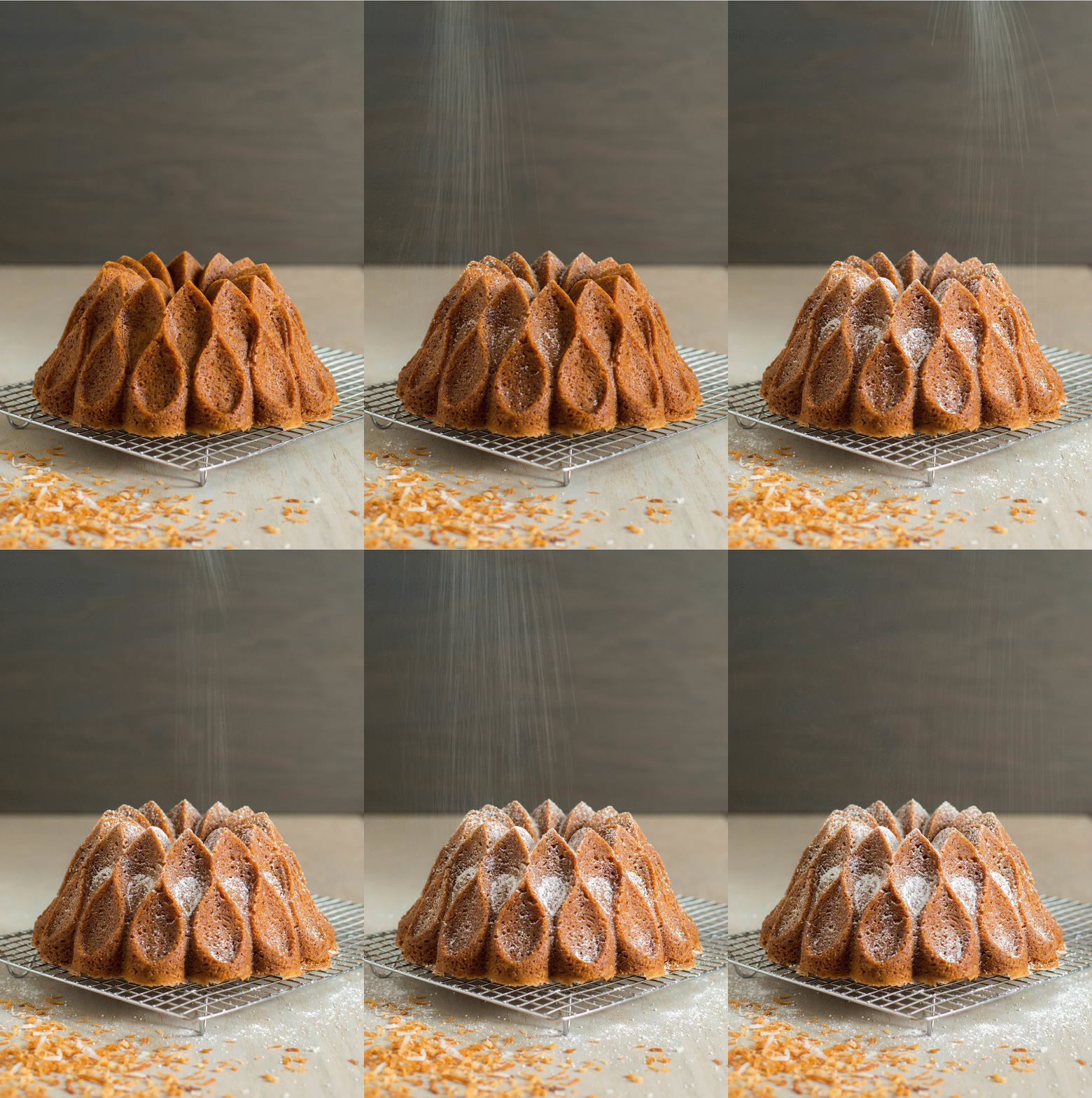
Cool for 15 to 20 minutes on a wire rack before inverting the cake onto the rack to remove the pan. Cool for at least 30 minutes more before dusting with powdered sugar. Store in under a cake dome, in an airtight container or tightly wrapped in plastic wrap to prevent the cake from drying out. If well stored, the cake should keep for several days at room temperature.

drømmekage (danish dream cake) bundt cake | Brooklyn Homemaker

There are so many mouthwatering bundts this month you can’t help but feel tropical. Regardless of what’s happening outside, you’re gonna need sunglasses to get through these amazing links!

.

BundtBakers

.
#BundtBakers is a group of Bundt loving Bakers who get together once a month to bake Bundts with a common ingredient or theme. We take turns hosting each month and choosing the theme or ingredient. You can see all of our lovely Bundts by following our Pinterest Board.

Updated links for all of our past events and more information about BundtBakers can be found on our homepage.