coconut curry squash soup

Have you been outside lately? No? Good. Don’t do it.

coconut curry squash soup | Brooklyn Homemaker

I’m not sure where you live, but if you live in the Northeast like me, specifically in New York City, then you know that this winter has officially been the worst. I’m no stranger to cold weather, I lived in the Adirondack mountains for several years, but New York City isn’t used to this amount of snow, especially not when it sticks around and piles up instead of melting after a day or two. The infrastructure of this great city is not designed to deal with this kind of build up and, much like the city’s inhabitants, there’s nowhere for it to go but up. The narrow strip of sidewalk between the road and the walkway carved out of the snow is the only place to put it, and in some places its reaching several feet high at this point.

To make matters worse, the weather has been pivoting back and forth between two stages lately. One day you’ll have complete white out snow coming at you from angles you didn’t know existed. Then the next day will be just warm enough for the piles of snow to start to melt, while simultaneously blocking all the storm drains, creating giant slush ponds at every cross walk in the five boroughs. Then we go back to white out conditions, the slush ponds freeze over, and we start the process all over again. When you consider that this is a city where most people who live here depend on public transportation and their own feet to get around, I’m sure you can imagine how all this snow and slush is starting to wear at people.

coconut curry squash soup | Brooklyn Homemaker

A few days ago it was looking pretty outside so I tried to wear a pair of less-than-waterproof leather boots to work. Call it hubris. Call it naiveté. Call it idiocy. Whatever you call it, I was out the door less than three minutes before my left foot was completely soaked. By the time I made it to work both my feet were soaked through and remained so for the entire day. If you’ve never tried to wear leather boots and thick wet socks while working on your feet for an eight-hour shift, I wouldn’t recommend it. If you’re considering it, trust me, it’s not what you might think. It’s not nearly as thrilling or dangerous as, say, spelunking, nor is it as relaxing as sitting in the sand and dipping your toes in the ocean.

coconut curry squash soup | Brooklyn Homemaker

As you can imagine, these past few weeks have left me wanting warm, hearty, filling meals when I get home and wring out my socks.  That’s what led me to this soup. I love a creamy traditional squash soup in cold weather, but the way things have been going I wanted to brighten that concept up with some summery, fresh flavors and a bit of citrus and spice. I thought that something about this combination of flavors might help me forget about the frozen hellscape outside, and boy was I right. There’s something so hearty, homey and comforting about a thick, creamy winter squash soup. Rather than flavoring it with traditional autumn or winter flavors though, the tropical flavors of coconut and lime take this to a totally different place. Since these traditionally Asian flavors are usually associated with thin brothy soups, I was a bit worried that the two concepts might clash, but they actually work really really well together. When you take your first spoonful, if you close your eyes and taste the chili, coconut and lime, you can almost imagine you’re somewhere warm and tropical. So, I cranked the heat in my apartment, put on some flannel pajamas and fuzzy slippers, and did my best not to dive into the bowl face first.
coconut curry squash soup | Brooklyn Homemaker

Because I have to be difficult, I couldn’t just find a recipe online and leave it at that, I had to make some changes to make it my own. The original recipe called for butternut squash, but I thought it would be fun to try a mix of different squashes for a depth of flavor. Along with butternut, I also used a pretty green kabocha squash. The flavors work really nicely together, but even with small squashes, twice the squash meant twice the soup. The recipe below feeds eight people so, unless you’re feeding a crowd, feel free to cut the recipe in half and choose one type of squash or the other. Both would be great on their own, so I’ll let you be the one to decide. The good news is that this soup freezes really well so, if you’re indecisive and want to make the full recipe, you can freeze your leftovers and pull a portion or two out on especially cold and crappy days.

coconut curry squash soup | Brooklyn Homemaker

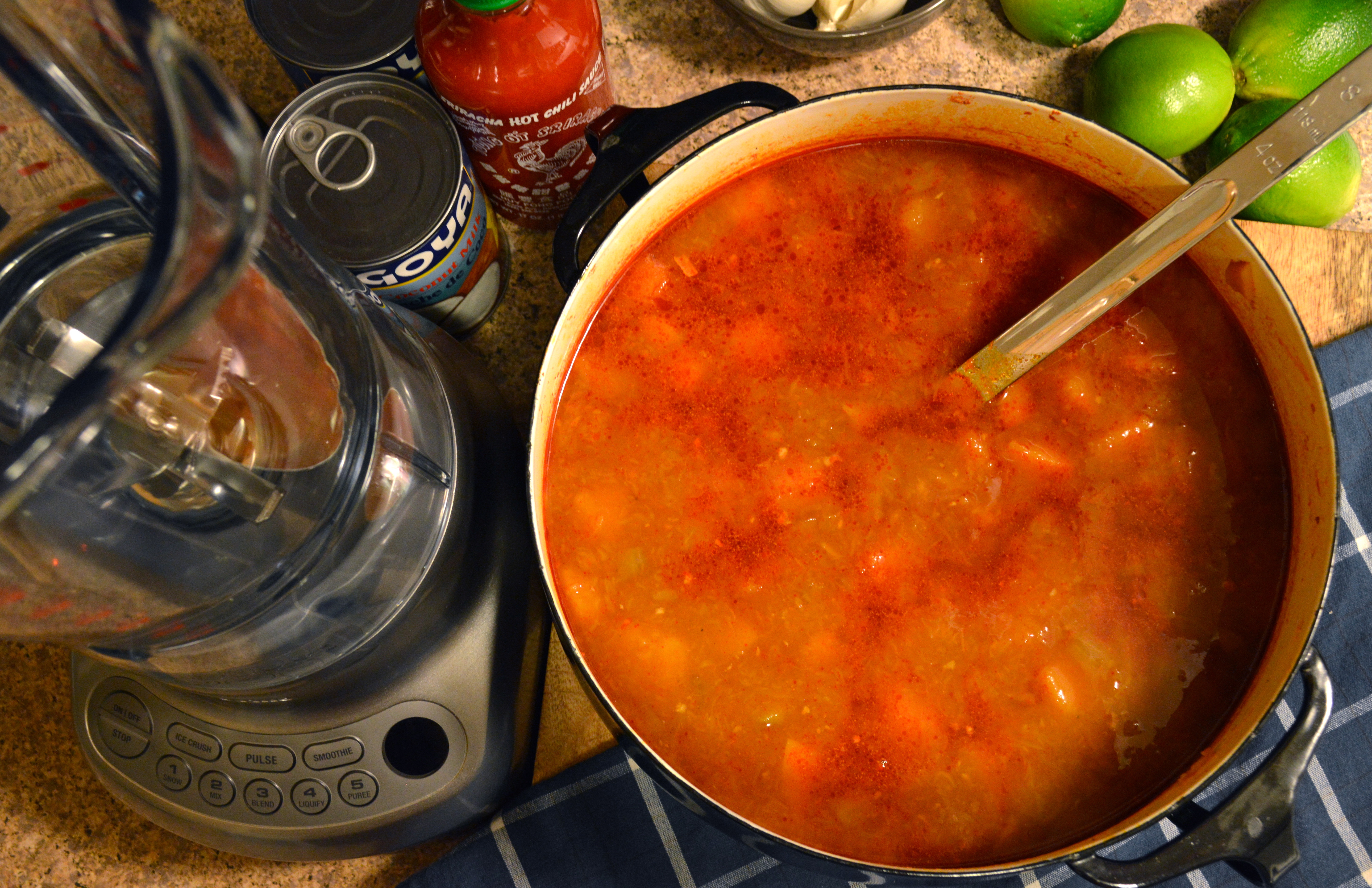
Another small change I decided to make was to use strips of ginger instead of grating it. Not only does this mean you save yourself the steps of peeling and grating the ginger, but it also means the finished soup has a slightly subtler ginger flavor. I love ginger but it can sometimes be a bit intense, so this way the strips steep in the soup as it cooks, and you pluck out them before you puree everything. I’d recommend that you count how many strips go into the pot so that you know how many need to come out at the end. If one or two elude you though, and make their way into the blender, it’s not really anything to worry about.

You will want to have a strong blender or immersion blender to make sure you get your finished soup completely pureed. For this soup you want the squash to add a creaminess, but don’t really want to have any chunks left since they’ll be kind of mushy. Since the finished soup is so silky, smooth, and almost drinkable, I think a garnish of fresh cilantro and chopped roasted peanuts or cashews adds a bit of texture and interest. Garnish or not, this soup is seriously delicious.

coconut curry squash soup | Brooklyn Homemaker

Oh hey friends! One last thing! If you’re as big a fan of Brooklyn Homemaker as I am, please vote for me for “Best Daily Read” cooking blog on theKitchn’s “The Homies”.  If I’m still in the top five at the end of the week, I’ll make it into the finals next week! So so exciting! Even if I don’t win, the exposure brings in lots of new readers, which is essential to the health of any good blog.
You’ll need to sign up for an account, but it only takes a second, and it means a lot to me. If you havent’ already, please show your support and vote for me here. And, seriously, THANK YOU!!! I never imagined I’d be doing so well so quickly when I started this blog last year. To be nominated, and to be doing so well, is such a  honor.
Okay, without further ado, the recipe…

Thai Coconut Curry Squash Soup

adapted from How Sweet It Is

2 tbsp coconut oil (or olive oil in a pinch)
1 onion, diced
6 garlic cloves, crushed or minced
1 four or five-inch piece of ginger, thinly sliced length-wise
4 tbsp red curry paste
6 cups vegetable (or chicken) stock
1 small butternut squash, peeled, seeded, and cut into rough cubes
1 small kabocha squash, peeled, seeded, and cut into rough cubes
2 (14-ounce) cans coconut milk
juice of 3 limes, about 1/2 cup
1 tsp sriracha (less if you’re scared, more if you’re feeling spicy)
1 tsp salt
1/2 tsp pepper
chopped cilantro, if desired
chopped roasted peanuts or cashews, if desired

Heat oil in a large pot over medium-low heat, add onions and season with salt and pepper. Cook until the onions are soft and translucent, about 5 minutes. Add in the garlic, (counted) ginger slices and curry paste, stir until it is incorporated, and cook for 2 minutes, stirring occasionally. Pour in the stock and add the cubed squash. Cover pot and increase the heat to medium. Cook until the squash is soft, about 30 minutes.

Once the squash is fork tender, turn off the heat, cool slightly, and very carefully pour the entire mixture into a blender, in batches. Blend until the soup is smooth and pureed. You could also do this with an immersion blender but be careful not to miss any squash. Pour the soup back into the pot and turn the heat to medium low. Add the coconut milk, lime juice, and sriracha. Stir well and cover, and cook for 10 minutes until it’s completely warm. Taste and season with salt and pepper if desired. If you’re feeling fancy, Garnish of chopped cilantro and roasted peanuts.

flaky salt & pepper buttermilk biscuits

Remember that time that I promised you a buttermilk biscuit post? Like New Year’s day? Yeah. I’ve been a very naughty blogger.

flaky salt & pepper buttermilk biscuits | Brooklyn Homemaker

Biscuits shouldn’t be rushed though. Flaky, buttery, light-as-air, homemade buttermilk biscuits are representative of a bygone era, an era when people took their time on the things that matter, and didn’t give me guff for taking too long to talk to them about biscuits.

The thing about homemade buttermilk biscuits is, well, that they’re freakin’ amazing. Those dense doughy things that come in a can from the grocery store shouldn’t be allowed to go by the same name. If you can master making a buttermilk biscuit from scratch, you’ll pretty much own the world. People will do things for you. Things that you can’t even imagine. People really don’t understand the power of a good biscuit. Where I live in Brooklyn there are just as many Southern restaurants as in the actual South, and while the food is legitimately amazing, the biscuits are decidedly sub-par. I’m convinced that this is NOT because biscuits are too difficult for them to master, but instead because they don’t understand the importance (and power) of good biscuits. They think of biscuits as an after thought, a less than, and something not worth their while to make well. Their loss. Our gain. We’ll stay in and make our own biscuits!

flaky salt & pepper buttermilk biscuits | Brooklyn Homemaker

A few decades ago, everyone’s grandmother knew how to make biscuits, and make them well, but increasingly, it’s a dying art. I think that these days people don’t make them because they’re afraid or intimidated by the process. I promise you though that biscuits are not that difficult to get right if you can get over the fear. It can take some practice to get them perfectly light and fluffy, but as long as you’re gentle and respectful of the dough, and don’t manhandle them too much, they’ll come out better than you can imagine. As you make them more and more often, the process will get easier and easier, and they’ll come out better and better.

flaky salt & pepper buttermilk biscuits | Brooklyn Homemaker

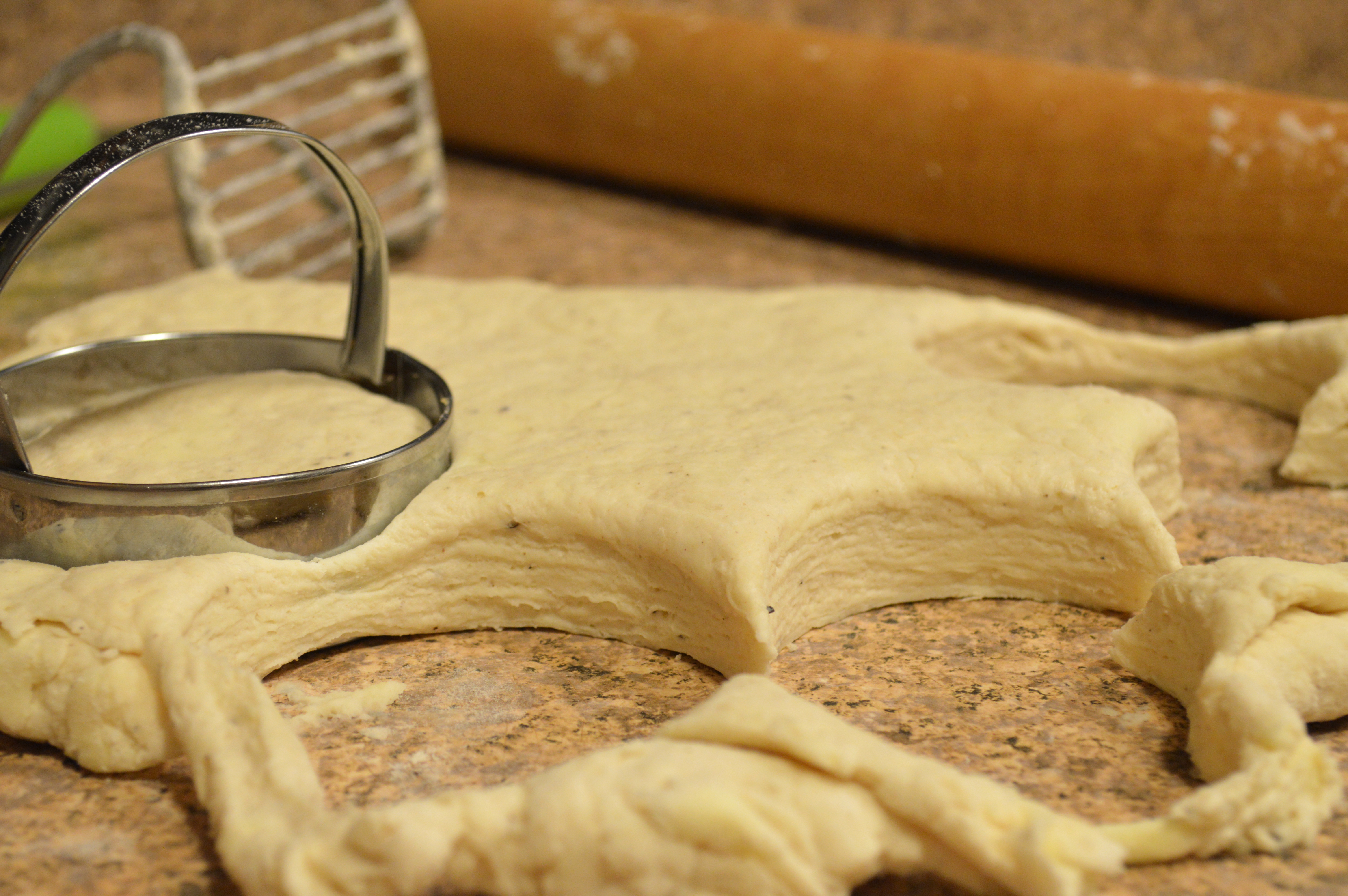
The trick to giving your biscuits flaky layers is to roll the dough out to about 1/2 inch thick on a floured surface, very lightly dust the dough with flour, and fold it over on itself. If you repeat this about 5 or 6 times (gently) you’ll have a good bit of nice tender layering. Simple.

Another thing I like to use to help make my biscuits impossibly light and airy is cream of tartar. Cream of tartar has absolutely nothing to do with tartar sauce, but is actually a bi-product of the wine industry. It has many uses in the kitchen, from stabilizing whipped cream to preventing sugar syrups from crystalizing; but for my purposes, in combination with baking powder, it helps baked goods rise Rise RISE .

One more thing I like to do to add a little something extra to my biscuits is to brush a bit of fat on top before baking. You can use melted butter or heavy cream, but either way this helps add an extra crunch to the tops of your biscuits, and helps make them come out slightly shiny, golden brown, and beautiful.

For this recipe I also added a little fresh cracked pepper to the mix, and topped them with pepper and coarse kosher salt for a bit of interest. Trust me though, without the salt and pepper these biscuits are still phenomenal. They really don’t need it, but I thought it would be a nice touch with the sausage gravy I was serving with them. You can leave out the salt and pepper if you like, and if you wanted to get crazy you could toss in something else. I’ve seen chives mixed into biscuits with excellent results, and I’ve even seen people mix in lemon or citrus zest! Yum!

One last thing that I think really helps make biscuits really special is a pastry blender. If you don’t have one you could also use food processor, a fork, or even your hands, but I really think you have more control with a pastry blender. The point is to cut the fat, in this case the butter, into the flour, and to do it with as little fuss as possible. Working the dough too heavily can cause the butter to melt or the gluten to form and make your biscuits tough, so I think a traditional pastry blender is the perfect way to cut your butter up into super tiny pieces without overworking the dough.
A pastry blender is basically just a series or wires or blades held together with a handle. I’ve used a few of them in my day, and my absolute favorite is this lil’ guy. I swear this pastry blender was sent to earth from heaven, just for me.  Some pastry blenders I’ve worked with in the past were a bit too flimsy to stand up to the beating I put them through, so I was thrilled when I found this one. The blades are thick and strong and don’t budge against even the coldest butter. The main difference between this and other blenders is that the blades are flat and straight instead of curved, but I don’t miss the curved design one bit.

flaky salt & pepper buttermilk biscuits | Brooklyn Homemaker

If you have a pastry blender you can throw a batch of biscuits together in 20 minutes or less. When we hosted Thanksgiving last year I spent the whole day cooking and cleaning and getting ready for our friends to arrive, but when the first guest rang the bell I realized I’d forgotten to make my biscuits. At first I thought I’d accept defeat and just skip them for the night, but then I thought twice and started pulling out the flour and butter. Even with guests milling around the kitchen, I had those biscuits in the oven so fast that my friend Isobel couldn’t believe it, and every time someone picked one up that night she’d proudly brag that I tossed them together in a flash at the last-minute.

I’m really not trying to toot my own horn though, I’m just trying to let you know that once you get the hang of doing this, it becomes second nature. The recipe I use is not some fancy Martha Stewart creation, or some decades old family recipe passed down from someone’s Southern grandmother, but a recipe I found in my 90s copy of the Better Homes and Gardens cookbook. It couldn’t be more simple. I’ve been making it for years, and while I’ve made some tiny tweaks, I think it’s totally perfect. I promise you that giving this recipe a try will be completely worth your while. So go ahead, impress your friends, and make some homemade biscuits.

flaky salt & pepper buttermilk biscuits | Brooklyn Homemaker

Salt and Pepper Buttermilk Biscuits

adapted from the Better Homes & Gardens Cookbook

3 cups all purpose flour, plus more for dusting
2 teaspoons fresh ground pepper, divided
4 teaspoons baking powder
1 tablespoon sugar
1 teaspoon table salt
3/4 teaspoon cream of tartar
3/4 cup butter (1 1/2 sticks)
1 1/4 cups buttermilk
2 tablespoons heavy cream or melted butter
1 teaspoon coarse kosher salt

Preheat oven to 450. In a large bowl whisk together flour, 1 teaspoon pepper, baking powder, sugar, table salt, and cram of tartar. Cut the cold butter into 1 inch chunks and add to flour. Cut butter into small pea sized pieces using a pastry blender, fork, or food processor. Make a well in the center of the bowl, pour in buttermilk all at once, and stir together with a fork until just moistened.

Turn dough out onto a lightly floured surface. Gently push dough out into a flat disk using your hands or a rolling-pin. Dust very lightly with flour, fold in half, and gently press it back out. Repeat 5 or 6 times to create layers in your biscuits that will separate when baked. Roll or pat dough out to 1/2 inch thick and cut into circles using a biscuit cutter. Remaining dough can be recombined once, but no more or it will get tough. Transfer biscuits to a baking sheet and brush tops with cream or melted butter. Sprinkle with salt and remaining pepper. Bake for 10-12 minutes, or until golden brown on top.

homemade dog food

If you haven’t noticed already, Russell and I really love our dogs.
And they love each other too! This is Doris on the left, and Betty giving her a kiss on the right.

homemade dog food | Brooklyn Homemaker

Since we’re young and both have full-time jobs, children are not something we see happening anytime in the immediate future. And hey, who needs diapers and vomit and crying and bad report cards when we have Doris and Betty?

Make no bones about it (pun absolutely intended), these dogs are spoiled. Their biggest daily challenge is deciding where to nap while we’re at work. They have free run of the house and yard, their treat jar has become a part of our decor, and they have more toys than some children. They even have their own toy box. I wish I could train them to put their toys away, but Betty would prefer that her toys are spread evenly throughout the apartment. When I tidy up she usually disapproves and goes back into the box to return two or three things to where she intended them.

homemade dog food | Brooklyn Homemaker

Doris was our first and she’ll always have a super special place in my heart for that reason. When we took this apartment we knew a pup was in our future but didn’t know when it would actually happen. We talked about it endlessly, discussing which breeds we liked best and thinking up potential names. We did a lot of dog sitting for friends to help get us ready and help us decide which breeds we liked best, and we fell completely in love with our friend’s adorable mini schnauzer, Belle.

One day as I was walking up to the apartment after work, I got a call from Russell. He said he’d found our dog and he was bringing her home with him right away. At first I was kind of annoyed that he’d fallen in love with a dog without my meeting her first, but as soon as they got home I knew he’d done the right thing. We’d just gotten engaged a few days earlier, and Doris was the best engagement present I ever could have received.

At just about seven pounds, Doris is much smaller than most miniature schnauzers. We’re so used to her size now that when we see other schnauzers they look gigantic to us! She’s perfectly laid back and relaxed and is a total little snuggle machine. She’s never happier than when curled up in one of our laps watching television. She absolutely loves to give us kisses, and if we let her she would just sit and lick our faces for hours on end. She’s also very quiet for her breed, and barely ever barks, though sometimes she does  talk to us in a funny low grumble to get our attention. Once you get her outside her personality changes a bit, and she loves to run and jump and play. She’s super fast and we often have people at the dog park tell us they can’t believe how she keeps up with dogs five times her size.

homemade dog food | Brooklyn Homemaker

About a year after Doris came to live with us, we started wondering if she gets lonely while we’re at work. The more we discussed it, the more certain we were that we wanted to add another pup to our little family. We had a wedding coming up though so not only was money tight, but we had a lot on our plates and training and caring for a new little dog was out of the question. We agreed to start the search when we returned from our honeymoon, but as a wedding gift, Russell’s sister Shannon and her family gave us an IOU for a puppy!

Once again, best gift ever. Thank you guys!

The only issue was that Shannon lives in California, and we’re here in Brooklyn. We thought about finding a dog in our area and asking Shannon to help pay for the adoption, but before we knew it, she found a beautiful little schnauzer in need of a new home. She lived with a very nice family near Shannon who needed to give her up because of a family emergency.  She was still a puppy, but the family had her completely house trained already! Score! To our surprise, Betty is even smaller than Doris, weighing in at just under six pounds!  Shannon has dogs of her own, and loves having animals in the house so she fostered Betty for us until Russell and I were able to fly out and get her. She was such a good girl on the plane home and just sat quietly with Russell the whole time. There was a little bit of jealousy between Doris and Betty at first, but now they love each other completely, and they’re totally inseparable.

Though they’re so close in size, Betty has a very different personality from Doris. Betty is an adorable little ball of energy, and spends half her day running back and forth between the living room and our bedroom window. She loves to sit in the window and stare out at the yard, keeping it safe from intruders. If a bird lands in the yard or a cat jumps the fence, Betty will loudly tell them they’re not welcome and come tell us we need to let her out to take care of business. She has a voice and she’s not afraid to use it, especially when she’s keeping us safe from the threat of a few sparrows grazing in our yard. She loves to play with her sister and they chase each other around the house and play tug of war constantly. When Doris needs a nap break, Betty keeps herself entertained by carrying her toys around in her mouth, or by chewing on deer antlers and nyla-bones for hours. She thinks of me and Russell as her personal jungle gyms, but she also loves to snuggle just as much as Doris. She isn’t as much of a kisser as Doris, but she does the most adorable thing to show her love by putting her little paw up and touching your face.

homemade dog food | Brooklyn Homemaker

Since these two girls are so important to us, I make them their own homemade food. We’re totally those neurotic dog parents.

The thing is, medical expenses add up, even when it comes to animals. We’re going to do anything we can do to help make sure our dogs stay happy and healthy. These little dogs eat better and healthier than Russell and I do, and I like to think of it as preventative medicine.

When it comes to feeding dogs, you have to be careful what you give them. Certain foods are definitely not good for dogs, and many foods that are fine for humans can be toxic to animals. You should never ever feed dogs any grapes or raisins, onions or garlic, chocolate, or alcohol of any kind. All of these foods can be toxic to dogs and can be very damaging to their health. Raw yeast dough can also be very dangerous, so be careful not to feed your pups any raw scraps when baking bread.

Foods that are beneficial for dogs include sweet potatoes, blueberries, carrots, pumpkin, green beans, and leafy greens. It’s great to feed your dogs a variety of vegetables so they get different vitamins and nutrients from a few sources. Apples make a great healthy treat, but you have to be careful to remove the seeds, which contain cyanide. Lean meats, eggs, peanut butter, salmon, and unsweetened plain yogurt are great sources of protein.  Cooked unsweetend oatmeal is a perfect source of soluble fiber and is a nice grain alternative for dogs with wheat allergies. If you’re not sure if certain foods are okay for dogs, the internet is a wealth of knowledge, so google away before feeding your dog a food they’ve never had before.

homemade dog food | Brooklyn Homemaker

I especially like to use lean meats and a variety of vegetables and greens. My family is big on hunting, so I’m lucky enough to have a source for free venison that I love to use for Doris and Betty’s food. Venison is super lean, and since the deer came from the wild instead of a factory farm, I know they ate a natural diet and weren’t fed antibiotics and hormones and all that nasty stuff. When I run out of venison I usually use lean ground beef or turkey. I also throw in chicken hearts and livers for added vitamins and goodness. Brown rice and oats add nice body and fiber to the food and help keep it moist.

I basically like to cut everything up in big rough pieces and throw it into a big pot with some water. I bring it all to a boil and simmer it long enough to cook the brown rice. Once it’s all cooked I puree it in a food processor in batches, mix it all back together, and divide it up into freezer safe containers to store in the freezer.

If you want to make this for your dogs, you’ll need a food processor or food mill and a very large stockpot. It’s not at all difficult, and depending on how much your dog eats, one batch can last more than month in the freezer. For some reason, the texture of this food improves after freezing. After it’s pureed it’s basically just paste, but once it’s frozen and thawed it firms up and is easily pulled apart with a fork.  For our girls, we feed them about an 1/8th of a cup of this food mixed with an 1/8th of a cup of dry kibble, and they are fed twice a day.

homemade dog food | Brooklyn Homemaker

Homemade Wet Dog Food

  • Servings: depends on your dog(s), this will feed our 2 small dogs for about a month
  • Print
4 lbs lean meat, like beef, turkey, or venison
1 1/2 lbs chicken hearts and/or livers
2 lbs braising greens, like kale, spinach, chard, or collards
1 1/2 lbs sweet potatoes (approximately 3)
1 lb apples (approximately 3)
1/2 lb carrots (approximately 3)
1 cup brown rice
1 cup oats (steel cut or rolled)
3 cups water
1/4 cup olive oil (or flax oil)

Wash and dry all of your vegetables and fruit. Tear the leaves of your greens off the rough stems and place into a large heavy bottom stock pot (at least 8qts). Cut ends off and roughly chop carrots and sweet potatoes. Add to pot. Quarter and core apples and add to pot along with rice, oats & water. Stir contents of pot. If not already cut up or ground, cut your lean meat into large pieces and add to pot. Place over medium high heat and bring to a boil. Reduce heat to a simmer and cook for 30 minutes. Add chicken hearts and livers and cook 15 minutes more. Remove from heat and let cool enough that you can handle it. Add oil and mix well.
Puree mixture in batches in a food processor. After each batch is completely pureed, add to a large bowl. When entire recipe has been pureed, mix well and divide into freezer safe containers. Before serving, thaw completely.

conversation heart mini cakes

Valentine’s Day is one of those holidays that most people either love or hate. Usually you hate it when you’re single, and suddenly appreciate it when you’re in a relationship. Growing up gay in a small town in upstate New York, for most of my life I was on the team against this holiday. Once I started dating I began to like it, but even then usually thought of Valentine’s Day as an excuse for restaurants to pack as many couples as possible into a tight space and charge a small fortune for a “prix fixe” menu. After a bottle (or two) of cheap champagne and several courses of dinner, I was usually done for the night, and that was that. Now that I’m married and don’t have to try so hard to impress my dates or seal the deal or whatever it is people do on Valentine’s day, I finally have a new appreciation for it. My husband Russell and I usually skip the over-priced meals and crowds and try to re-create the date experience at home. We like to use this holiday as an excuse to brighten our home with fresh-cut flowers, cook a nice meal, drink some wine and, of course, buy some chocolates. My favorite part of this holiday was, is, and always will be the chocolates.

conversation heart mini cakes | Brooklyn Homemaker

This day hasn’t always been all about chocolates and flowers though. Valentine’s Day has its roots in ancient Rome, and the holiday’s two namesakes were Roman saints who both shared the name Valentine. Though there are some rumors, there is no evidence linking either saint to the romantic ideas people have about the holiday today. Back then this holiday was strictly about martyrdom and religious beliefs. It wasn’t until the medieval era, when the tradition of courtly love flourished in the spring, that people started tying Saint Valentine’s Day to romance and love.  Men would pick spring flowers and write love songs to try to woo their fair maidens, but even then sugar was a precious commodity in Europe, so candy wasn’t yet a part of the experience.

conversation heart mini cakes | Brooklyn Homemaker

It wasn’t until the 1800s that the British chocolate manufacturer Cadbury started marketing chocolate candies for Valentine’s Day. Before then, chocolate was usually consumed as a hot beverage. When Cadbury made some improvements to its chocolate manufacturing technique they were left with an excess of cocoa butter. It was then that they started to produce a wide array of their “eating chocolate” and recognized Valentine’s Day as a marketing opportunity. Richard Cadbury started designing and selling ornate decorated boxes filled with an assortment of his new chocolate candies.  Victorians were already in the practice of showering each other with cards and gifts for Valentine’s Day, and Cadbury’s chocolate boxes were a wild hit. Within a few decades these elaborately decorated boxes were everywhere, and their popularity continued to grow until governments started rationing sugar during World War II. By then the idea of candy, chocolate, and heart-shaped everything was deeply tied to Valentine’s day, and continues to be today.

conversation heart mini cakes | Brooklyn Homemaker

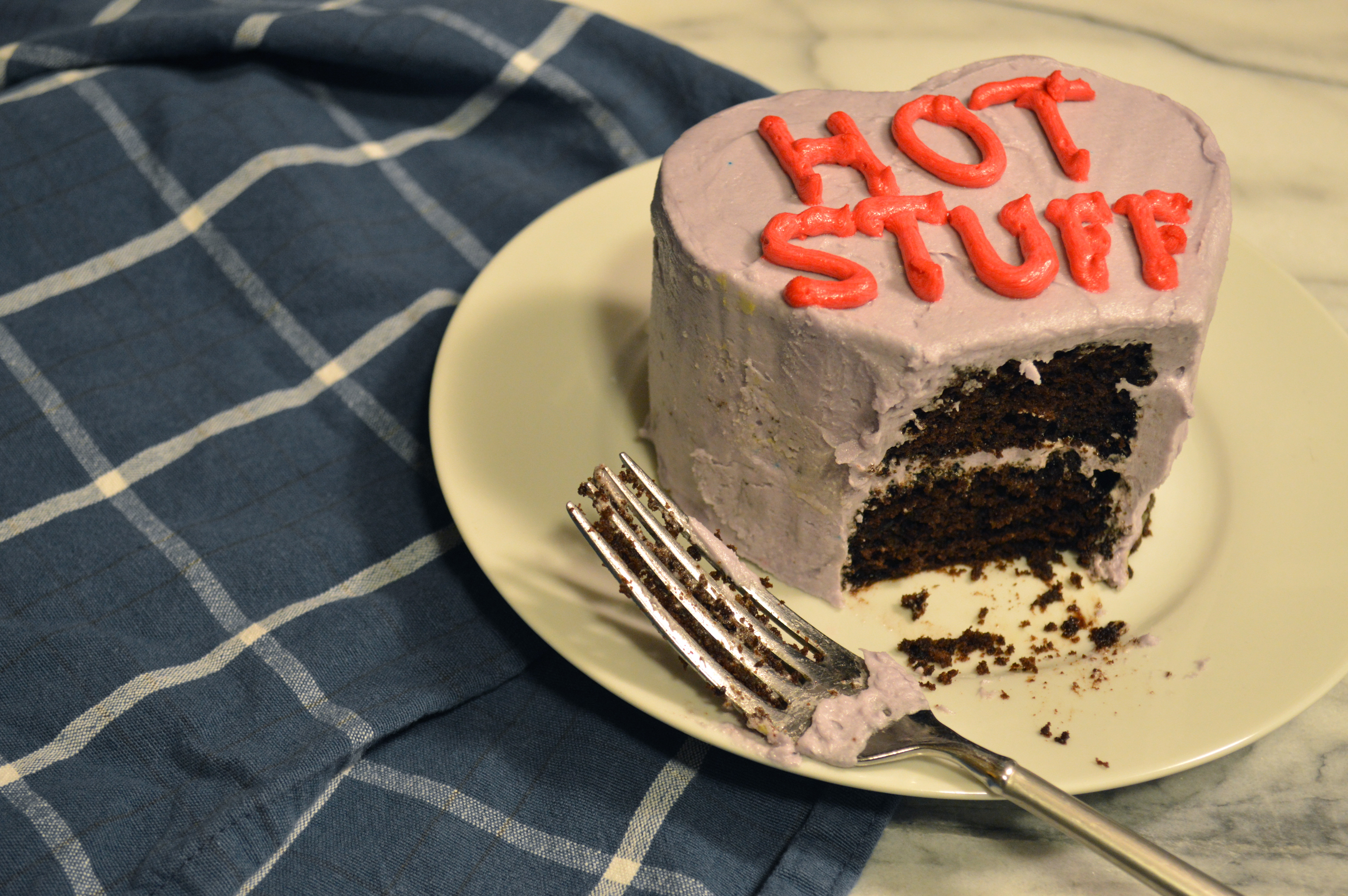
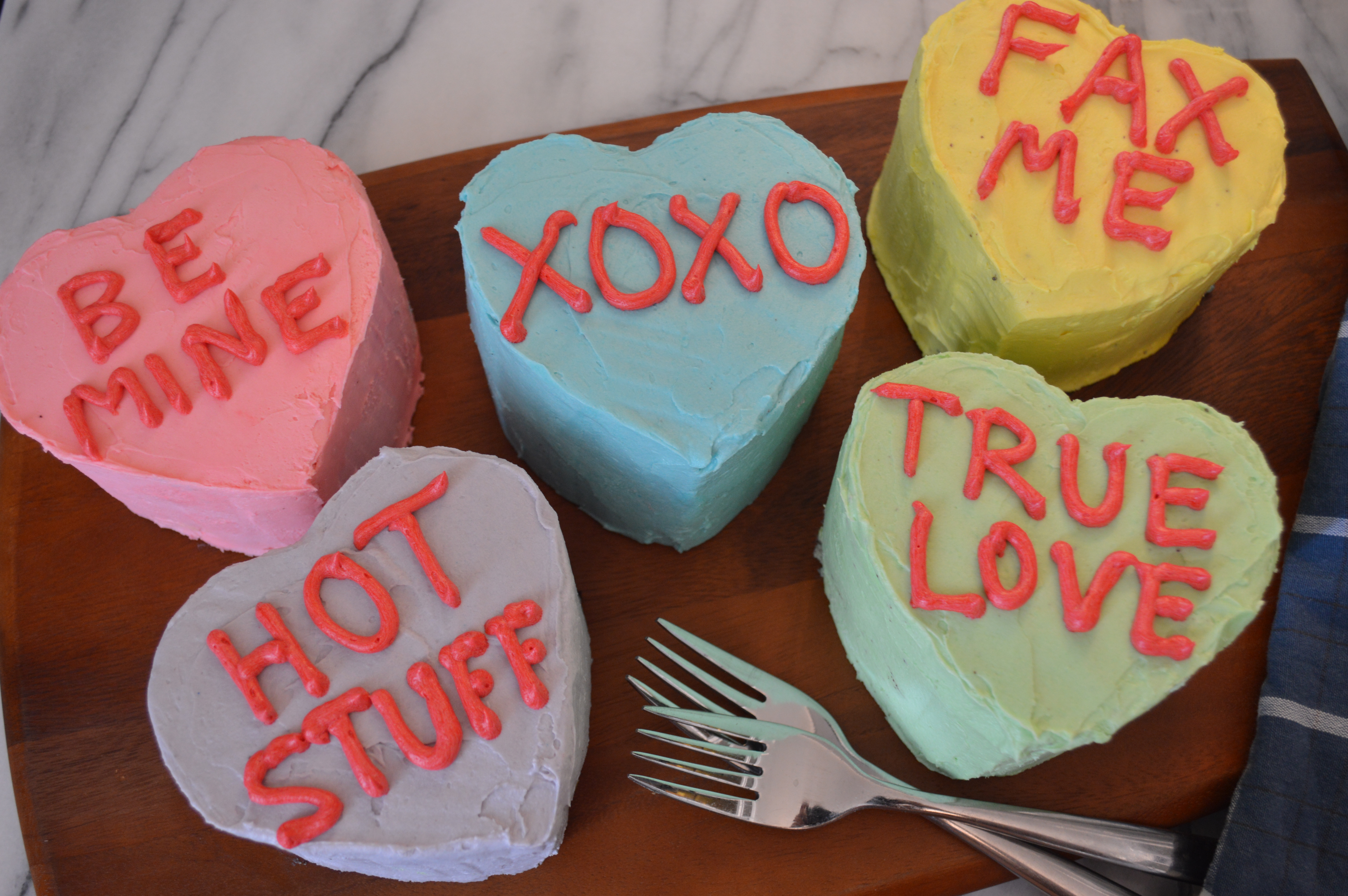
Another Valentine’s Day confection that roots back to Victorian England is the conversation heart. The English had a tradition of writing phrases and sayings on small pieces of paper embeded inside of small colored sugar candies. The Victorians took this fashion even further by creating “conversation lozenges”, which came in various sizes and shapes, and were common all year round. Some of the more common phrases on them included “Can you Polka?” and “How do you flirt?”, but they were even sometimes used as marketing tools with the names of businesses written on them. In 1866 a device was invented to imprint the phrases into the candies rather than hand writing them, and in 1901 the Necco company, makers of Necco wafers, starting cutting their conversation lozenges into heart shapes and marketing them as Valentine’s Day “Sweethearts”. For decades some of the most popular phrases on conversation hearts were “Be mine”, “Kiss Me”, and “I’m Yours”. In the 1990s the company decided to update some of their phrases and retire others, introducing new phrases like “Email Me”, “Hot Stuff”, and Russell’s favorite, “Fax Me”.

conversation heart mini cakes | Brooklyn Homemakerconversation heart mini cakes | Brooklyn Homemaker

When I was trying to decide on a dessert to make for Russell on Valentine’s Day, I thought it would be really fun to try combining these two traditions. I’m not really a fan of real conversation hearts, but I am a big fan of chocolate! So, prepare to have your mind blown, I decided to make conversation hearts made of chocolate! Boom. Rather than trying to make tiny hearts out of real chocolate I decided that little chocolate cakes were where it’s at.

conversation heart mini cakes | Brooklyn Homemakerconversation heart mini cakes | Brooklyn Homemaker

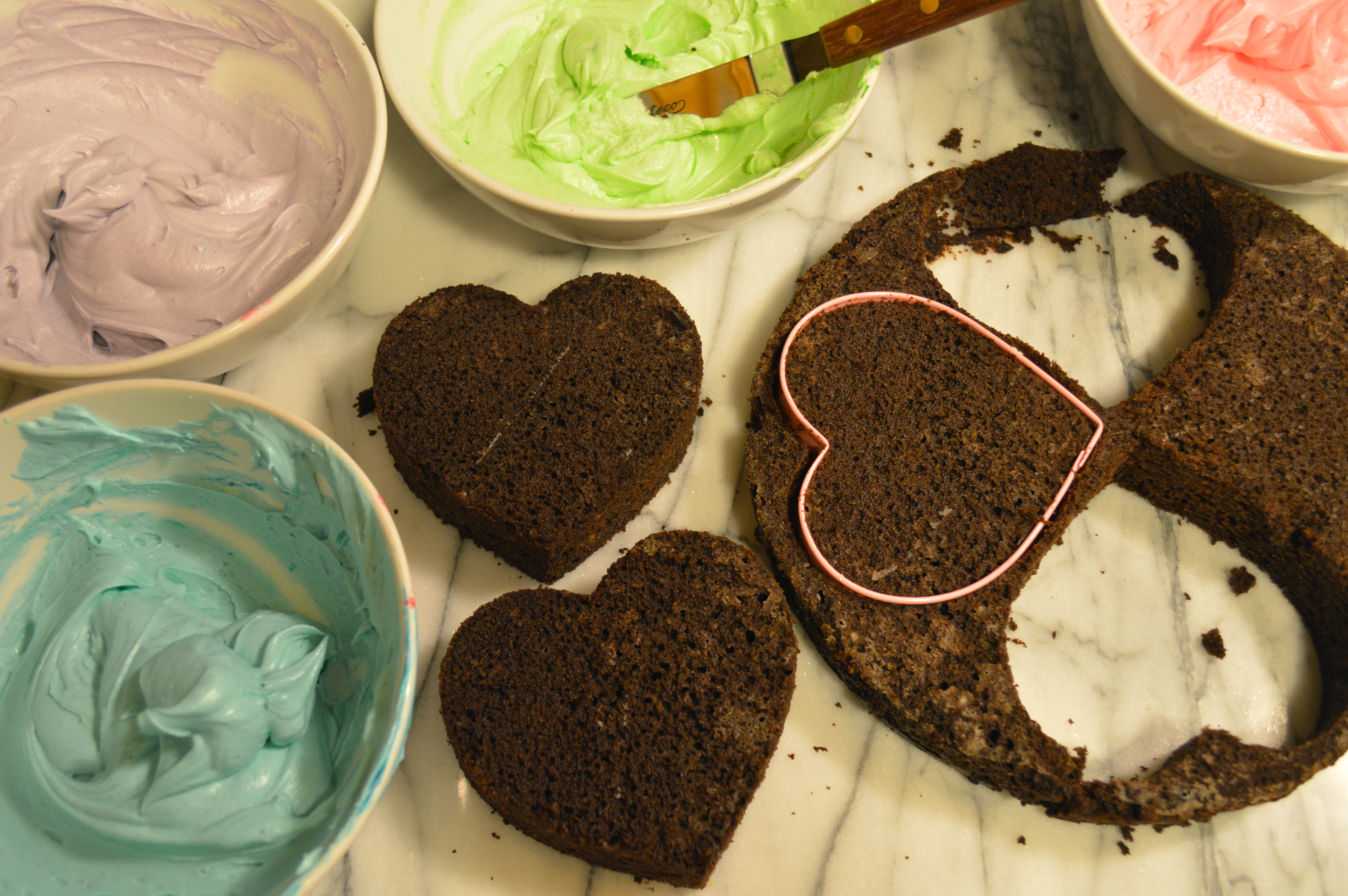
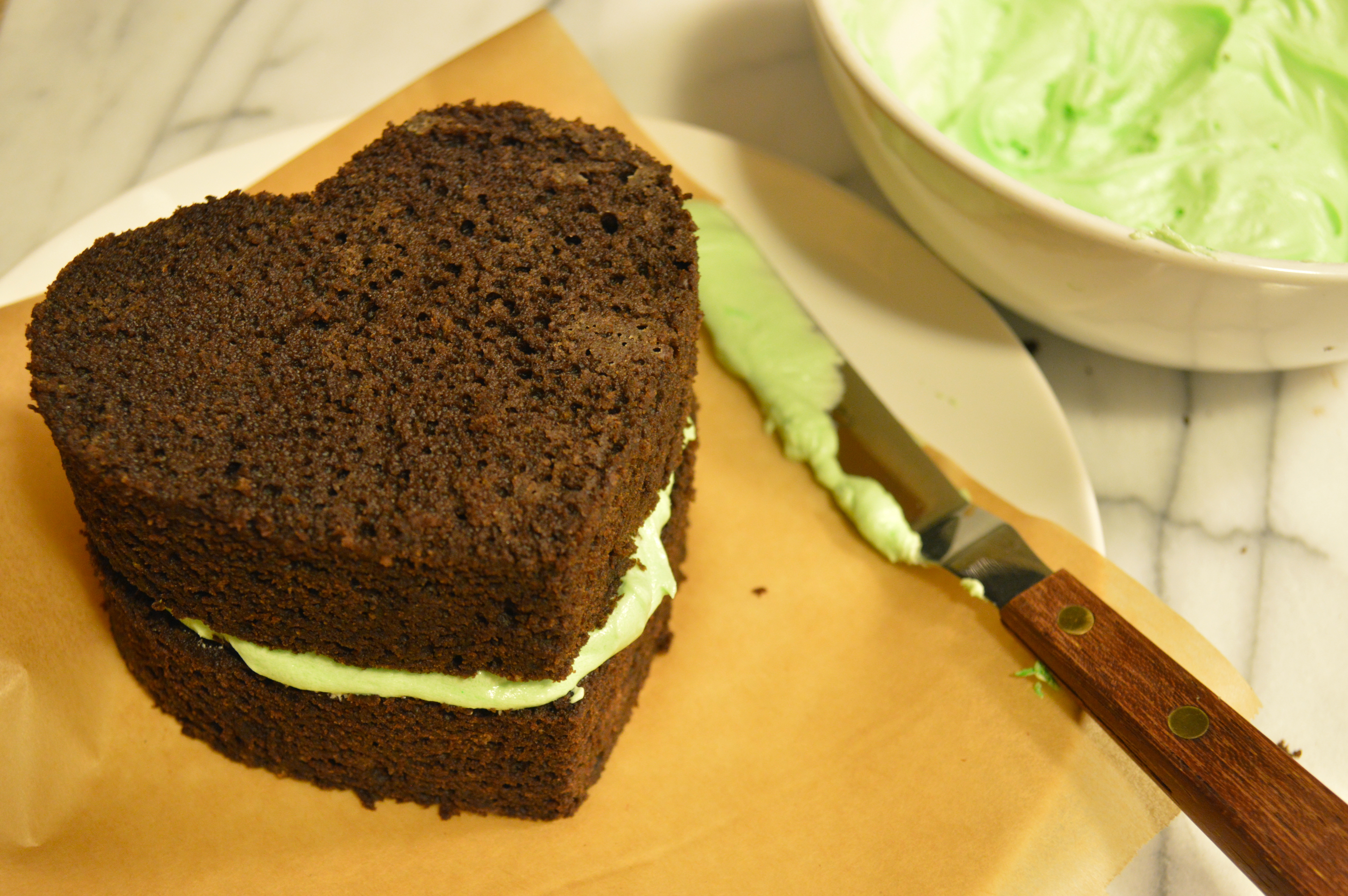
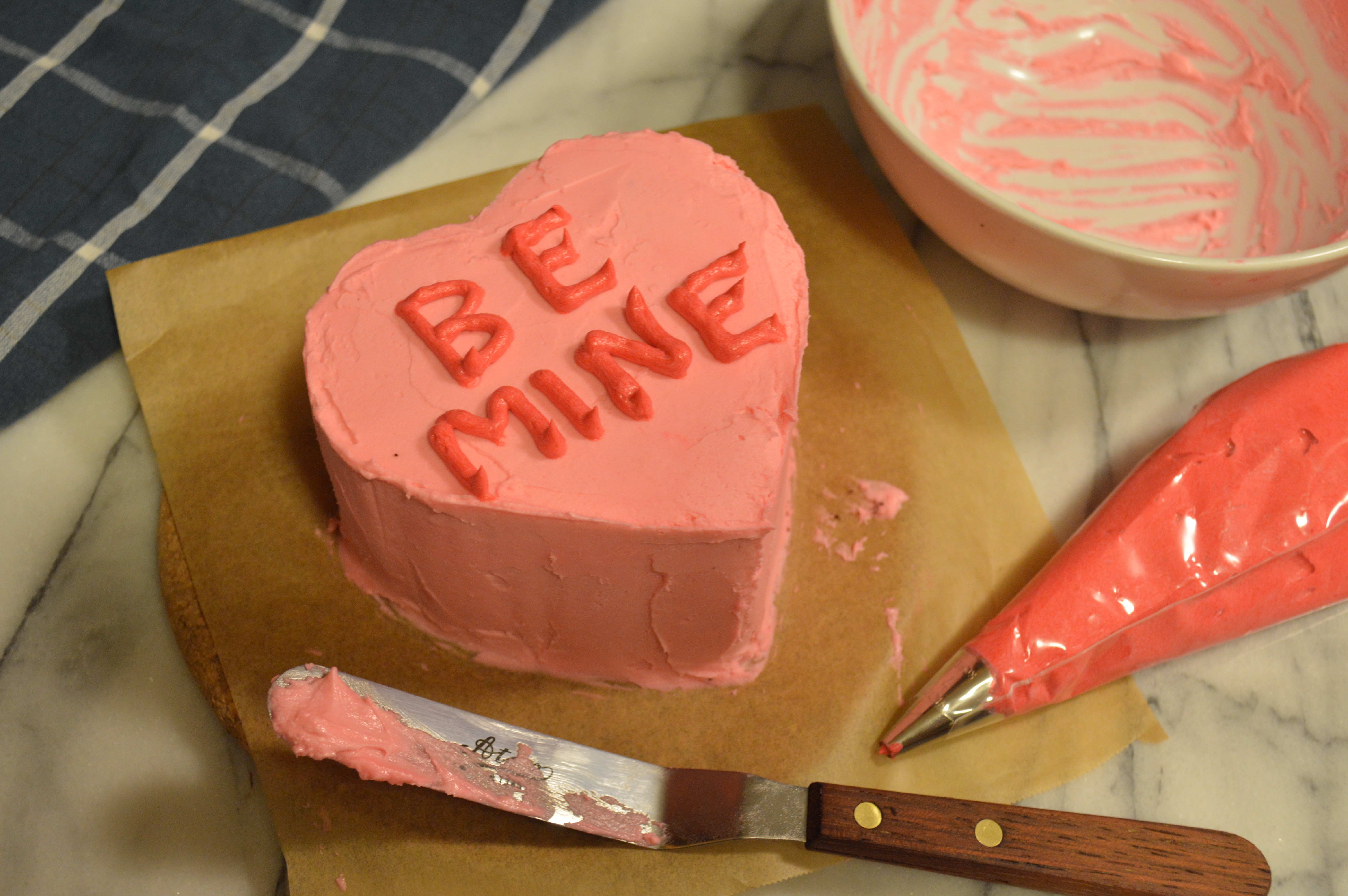
I started with my favorite recipe for Devil’s Food Cake from Russell’s birthday, but decided to ice them with a traditional American buttercream. For fancy layer cakes I’m usually a bigger fan of meringue buttercream because American buttercream tends to be too sweet and have a slightly gritty texture, but I thought it was the clear choice for these cakes. Since they’re so cutesy and retro, and since they’re the size of large cupcakes, I thought this old school classic would be the perfect complement. I baked three 9-inch layers of Devil’s Food Cake and used a 4-inch heart-shaped cookie cutter to cut out twelve Devil’s Food hearts. Then I filled, stacked, and iced the hearts to make 6 mini heart layer cakes. To make the cakes look just like traditional conversation hearts, I chose pastel tones for my icing and piped on phrases in red.

conversation heart mini cakes | Brooklyn Homemaker

Not only are they completely adorable, they’re totally delicious. Super moist, tender & chocolatey cakes covered with rich sweet & creamy icing. Heaven. The recipe below makes 6 cakes, which each feed 2 people at least, so they’re perfect for a party. If you wanted to just make 2 heart cakes you could cut hearts from one layer and freeze the other two layers of cake for another use. If wrapped good and tight in plastic, these cake layers should keep for up to a month in the freezer.

I really hope you give these a try. They might be a little advanced for beginners, but if you are a confident crumb-coater and can pipe a straight line, I promise you can handle it.

conversation heart mini cakes | Brooklyn Homemaker

Conversation Heart Mini Cakes

  • Servings: makes six 2-layer 4-inch heart cakes, serves 12ish
  • Print
Devil’s Food Cake

butter and flour for pans
2 cups peanut oil or vegetable oil
1 1/2 cups unsweetened natural cocoa powder
1 1/2 cups hot water
3 1/4 cups cake flour
1 1/4 teaspoons coarse salt
1 teaspoon baking powder
1 teaspoon baking soda
1 cup granulated sugar
1 1/4 cup packed brown sugar
4 large eggs
4 teaspoons vanilla extract
1 cup buttermilk

Preheat oven to 350 degrees. Butter three 9 inch round cake pans, line bottoms with parchment paper, butter paper, and dust pans with flour. Whisk together cocoa powder and hot water until smooth.

Sift together flour, salt, baking powder, and baking soda; set aside. Beat oil and sugar together on medium-low speed until combined.
Add eggs, one at a time, beating after each addition. Beat in vanilla and cocoa mixture. Reduce speed to low. Add flour mixture in two batches, alternating with buttermilk and beginning and ending with flour. Beat until just combined.
Divide batter between pans, and bake until a cake tester inserted into centers comes out clean, 35 to 40 minutes. Transfer pans to a wire rack to cool for 15 minutes. Invert cakes onto rack, peel off parchment, and let cool completely.

Classic American Buttercream
just enough for six 4″ heart cakes

2 cups unsalted butter (4 sticks or 1 pound), room temperature
6-8 cups confectioners sugar, SIFTED
1/2 teaspoon table salt
2 tablespoons vanilla extract
4-6 tablespoons milk

Beat butter for a few minutes with a mixer with the paddle attachment on medium speed. Add first six cups of confectioners sugar, one cup at a time, with your mixer on the lowest speed until the sugar has been incorporated. Increase mixer speed to medium and add vanilla extract, salt, and 4 tablespoons of milk and beat on high for 3 minutes. If your frosting needs a more stiff consistency, add remaining sugar, a cup at a time. If your frosting needs to be thinned out, add remaining milk 1 tablespoons at a time. For these hearts you want the icing fairly stiff.

Assemble the heart cakes

Wrap each 9″ cake layer in plastic wrap and refrigerate for at least an hour, or over night. Level each layer with a sharp bread knife or cake leveler, and using a 4″ heart-shaped cookie cutter, cut four hearts out of each layer, giving you 12 hearts. Keep the heart cut-outs cold in the refrigerator while you’re working on each cake.

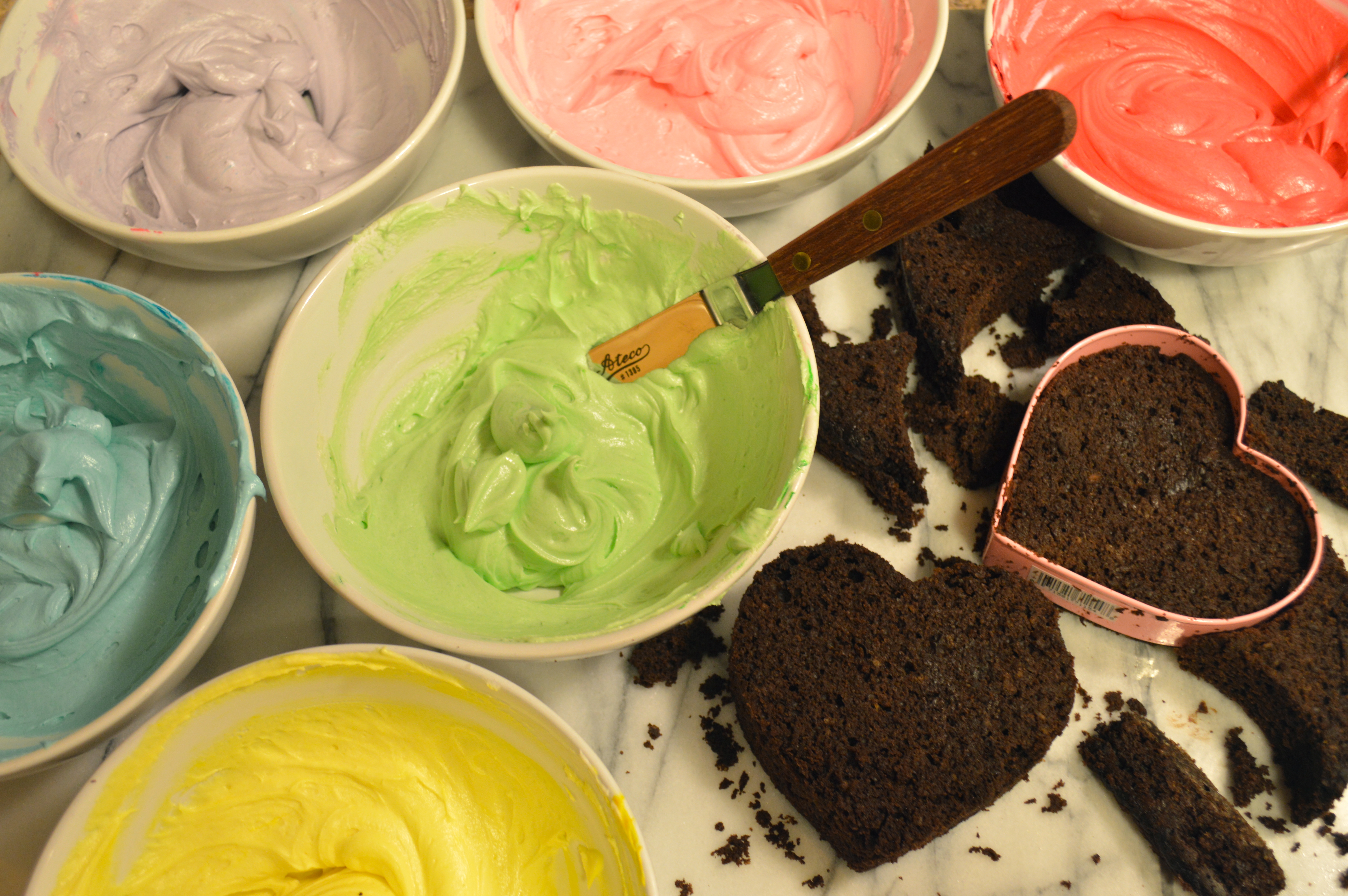
Divide your icing into 7 bowls. You’ll need about a cup of icing for each of the six cakes, and about 1/2 a cup of icing for the seventh bowl which you’ll use for the writing. Color the writing icing bright red, and then color each of the 6 remaining bowls whichever colors you prefer. Keep in mind that conversation hearts come in pastels so go easy on the food coloring. Fit a piping bag with a medium writing tip, I used a Wilton #7 , and fill the bag with your 1/2 cup of red icing. I used CK Products gel colors (available here) to avoid thinning out the icing. A little goes a long way, so use sparingly.

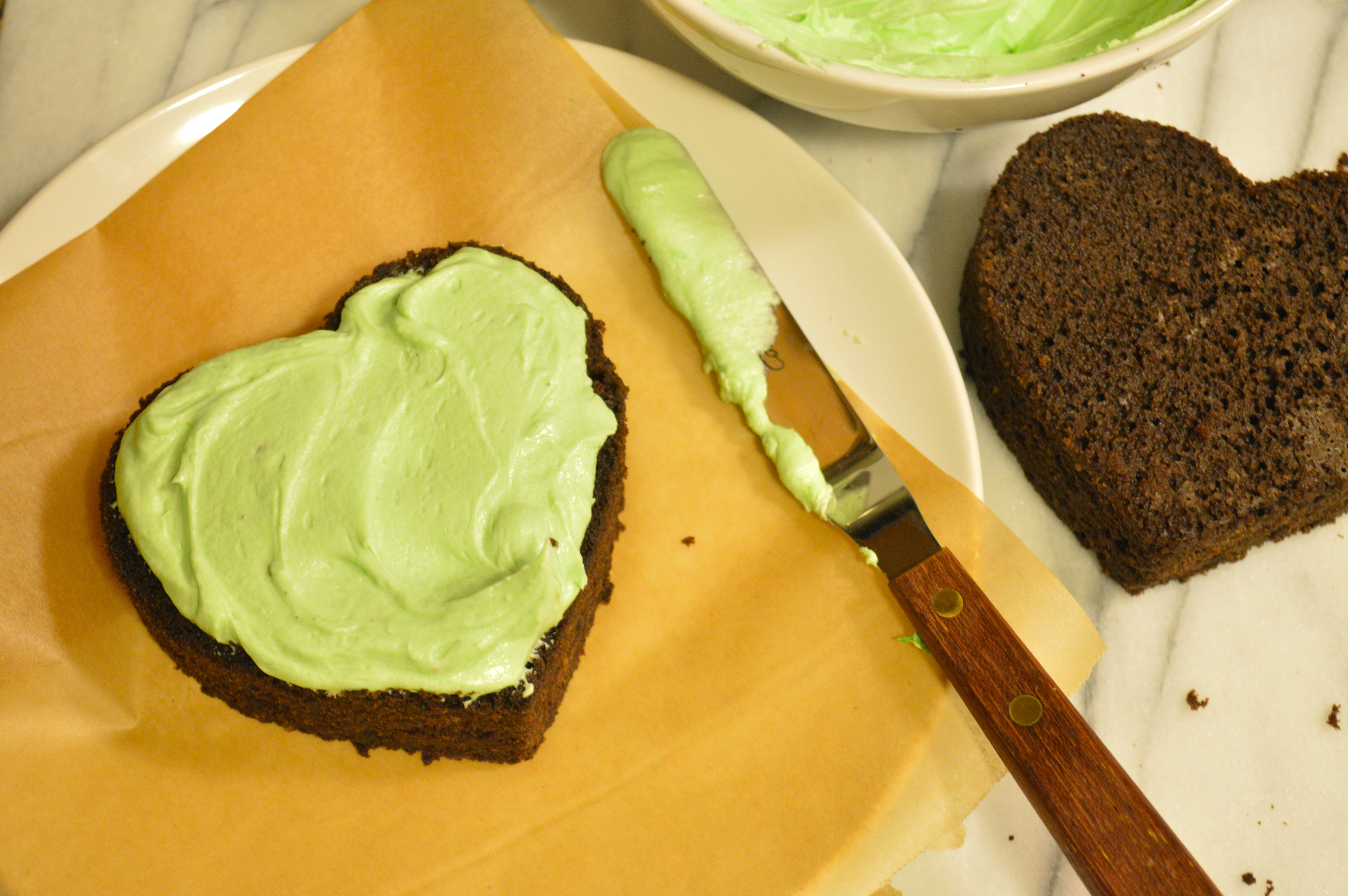
Working with one color at a time, spread about 1/4 cup of icing on the top of one heart cut-out and layer with another cut-out. Using another 1/4 cup of icing spread a thin layer to cover sides and top of the cake. This is called the crumb coat, and since these cakes are cut-outs they produce a lot of crumbs. This step is very important if you don’t want visible crumbs in your icing. Once your cake is completely crumb coated, refrigerate while you work on remaining five cakes. Repeat until all 6 cakes are crumb coated and each has refrigerated for a minimum of 30 minutes or more.

Working with the same color the cake was crumb coated with, ice each cake with remaining 1/2 cup of icing. Use a small offset icing spatula to get a nice smooth finished surface. Once iced, write your favorite conversation heart phrase on top with red icing. Repeat with remaining five cakes. Take pictures and show your friends, family, co-workers, first grade teachers, and college RAs.